
New Fascia Boards, Soffits and Bargeboards: Cap Over or Rip Off Is the Whole Decision
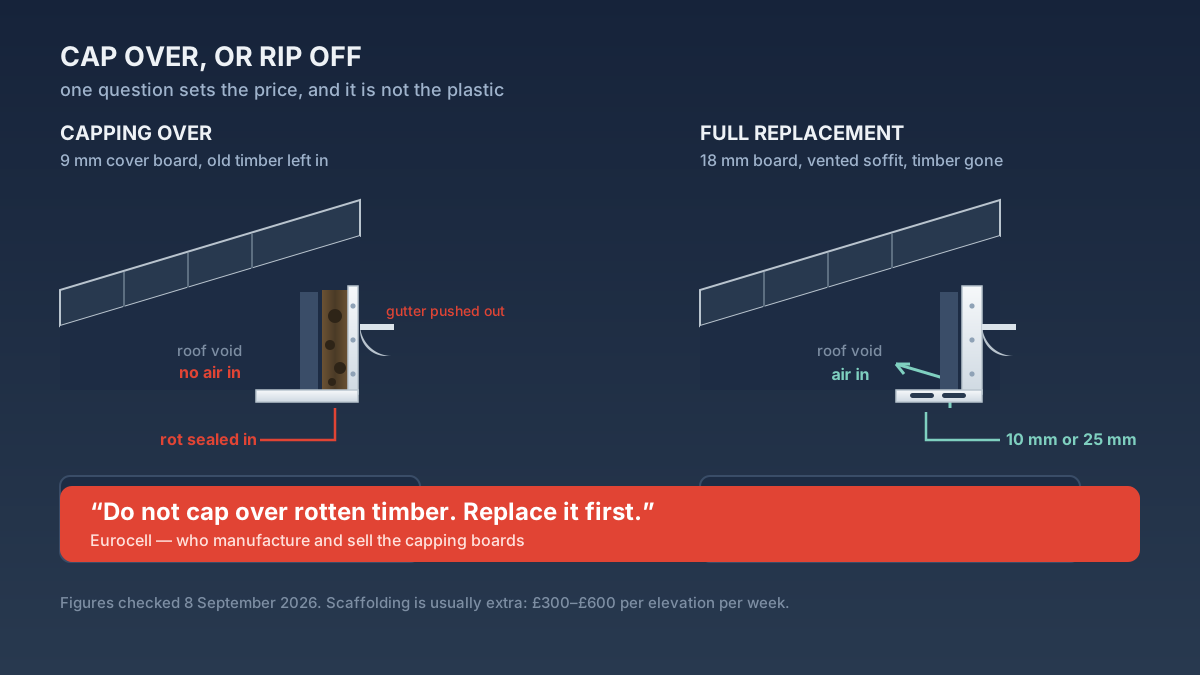
Two quotes for the same roofline can differ by two thousand pounds, and it is almost never about the plastic. One firm is screwing a 9 mm cover board over your existing timber; the other is taking the timber off. Eurocell, who make and sell the cover boards, say plainly: “Do not cap over rotten timber. Replace it first.” Everything else on this page is detail.
The short answer
Decision one: is the timber behind sound, or is it not? That single question sets your price, and no one can answer it from the pavement. If the existing fascia is solid, a capping board (a 9 mm uPVC cover screwed over the top) is a legitimate job. MyJobQuote put capping a 3-bed semi at £800 all in (updated 27 January 2026). If the timber has gone, you need full replacement, and Checkatrade’s estimators put a small semi at £2,750 excluding scaffolding (cost guide dated December 2025). That gap, roughly £800 against £2,750, is why the cheap quote is nearly always the capping quote, and why it is worth knowing which one you are being sold.
The trap, in the words of the people who sell capping boards. Eurocell manufacture uPVC capping. Their own guidance says capping suits a fascia that is “in good enough condition to act as a backing”, and then: “Do not cap over rotten timber. Replace it first”, because “rotten timber should be removed and replaced before fitting capping boards”. They also note that 9 mm capping boards are not load bearing. If a manufacturer is telling you the limits of their own product, believe them. Enhance Exteriors, a Hertfordshire roofline firm, photographed exactly the failure: capping removed at a Baldock house to reveal severe rot underneath, water getting into the property and a mould problem.
Decision two: whatever you fit, do not close up the roof. This is the one that costs you a roof, not a fascia. The Planning Portal’s own wording on fascia replacement: “check that the replacement work does not reduce the ventilation provided to the roof void as this could cause condensation to occur within the roof void, which can then lead to damp on the timbers”, and “if the existing system has vents installed a similar system will need to be maintained”. Marley put the BS 5250 numbers at 25 mm of continuous eaves ventilation for pitches of 15° or less and 10 mm above 15°. A solid soffit fitted over what used to be an open, breathing eaves is a slow, expensive mistake.
What we would do. Get one section opened up before you accept any quote. If the timber is sound, cap it and save the money. If it is not, replace it. And if a quote does not say in writing which of the two it is, it is not a quote, it is a number.
What a uPVC fascia board costs on the shelf
| Where | Board | Size | Price | Per metre | Rating |
|---|---|---|---|---|---|
| Eurocell (direct) | Euroboard smooth standard fascia code EB17564, full replacement | 5 m × 175 mm × 18 mm | £26.00 inc VAT (£21.67 ex) | £5.20 | None with a sample size |
| Toolstation | 9 mm white cover fascia board unbranded; capping, fits over existing timber | 4 × 3 m × 175 mm × 9 mm | £75.99 inc VAT, 12 m total | £6.33 | 5/5 from 102 |
| Screwfix | FloPlast Mammoth fascia full replacement | 2 × 3 m × 175 mm × 18 mm | £44.99 inc VAT, 6 m total | £7.50 | 5/5 from 1 (not evidence) |
| B&Q | FloPlast Universal fascia thickness not published on the listing | 2.5 m × 175 mm | £25.44 | £10.18 | 4.6/5 from 23 |
| Bradfords (the timber option) | PSE grooved redwood fascia planed, untreated, so you finish it | 25 × 175 mm (finished 20 × 169) | £12.38 / m inc VAT (£10.32 ex) | £12.38 | None published |
| Screwfix (the soffit) | FloPlast multipurpose soffit board unvented; you add vents | 2 × 3 m × 304 mm × 10 mm | £49.99 inc VAT, 6 m total | £8.33 | 4.9/5 from 12 |
Every price read off the seller’s own product page on 8 September 2026. Per-metre figures are our arithmetic on the pack contents. Eurocell and FloPlast both carry a 20-year manufacturer’s guarantee (FloPlast’s requires registration); Toolstation’s unbranded cover board states none. Note the two 18 mm boards are structural replacements and the 9 mm Toolstation board is a cover. They are not the same product doing the same job. We could not read Wickes’ prices: their category and product pages returned only navigation to us, twice.
What the 2021 version of this page said, and what is wrong with it
This page has carried the same URL since 21 February 2021. The old version is still readable and it is thin: three headings (“What Are Soffit Boards?”, “Fixing Those Fascia Boards”, “Replacement Fascia Boards”), no prices at all and not one source. We are not going to quietly swap it out.
“Maintenance free” and “improves property value”
It called uPVC roofline “maintenance free”. It does not need painting, which is true; maintenance free is marketing. Eurocell’s guarantee on the board we priced is 20 years against cracking, warping or discolouration. That is a defined period against three defined failures, not a promise of permanence, and the fixings, joints and gutter brackets can all still fail. On value, the old page simply asserted it; we looked and found no sample-sized UK evidence putting a figure on what new fascias do to a sale price, so that claim is now in the caveats box rather than the copy.
The thing it left out entirely
It treated this as a straightforward DIY job and mentioned 65 mm stainless steel fasteners, which is sound advice as far as it goes, since galvanised nails bleed rust down white plastic. But it said nothing about ventilation, scaffolding, asbestos in pre-1985 soffits, or the capping-versus-replacement decision that sets the entire cost. Those four are most of this rebuild.
Cap over or rip off: the money, and the risk
Capping is real work with a real product. Eurocell make it, sell it, and describe its proper use: “covering older timber fascia boards” and “refreshing tired or peeling roofline boards” where the existing timber is sound enough to act as a backing. Done on sound timber it is cheaper, quicker and less disruptive.
What goes wrong when it is done on rotten timber
Roofline Replacement, a specialist installer, list three failure modes and they are all mechanical rather than mysterious. First, “when you clad over that timber, you seal the rot inside”, and the fungal growth can carry on into the rafter feet. Second, the extra thickness pushes the gutter outward so rainwater can “overflow the gutter or run behind it”. Third, the new plastic is fixed into decaying wood, so as the wood goes “the nails lose their grip” and the board rattles or works loose in wind. They put capped work at 3–5 years before problems appear against 20+ years for a full replacement. That is one installer’s claim, from a firm that sells full replacements, and we have no independent test of either figure. But the mechanism they describe matches what Enhance Exteriors found under the capping at Baldock.
The number that gives it away
Roofline Replacement open their piece with two quotes on one house: £2,500 against £1,200, the difference being method rather than materials. That maps onto MyJobQuote’s £800 capping a 3-bed semi against Checkatrade’s £2,750 replacing a small semi. If one quote is roughly a third of the others, you have not found a bargain. You have found a different job. Conversely, if a competent person has opened up the eaves and the timber is dry and solid, capping is the sensible buy. Just get the inspection in writing and check the gutter still sits where the water lands.
The ventilation rule, in numbers
Your roof void needs to breathe. Rebuilding the eaves is exactly when that gets closed up, and the damage shows years later as damp rafters rather than immediately as a leak. Replacing fascias and soffits does not normally need building regulations approval and is not notifiable, according to the Planning Portal. But their guidance carries the ventilation warning quoted at the top of this page, and the operative sentence is that “if the existing system has vents installed a similar system will need to be maintained”. Not notifiable is not the same as unregulated in effect.
What the standard says
Marley, reading BS 5250 (Management of moisture in buildings — code of practice) for a cold pitched roof with a non-breathable underlay: 25 mm of continuous ventilation along the eaves at pitches of 15° or less, 10 mm above 15°. Roofs over 35°, spans over 10 m and lean-to designs want a further 5 mm at high level. With a breathable underlay the requirement changes and depends on how well the ceiling is sealed, which is another way of saying do not guess.
What that means at the merchant
FloPlast sell pre-vented soffit with slots giving “a 10 mm or 25 mm wide clear air gap, which conform to current building regulations”, and separately a plain multipurpose board you add circular vents to. The £49.99 board in our table is the unvented one. Buy that and fit nothing else and you have sealed your eaves. Where insulation is stuffed into the eaves and blocks the soffit route, over-fascia vents and eaves support trays are the answer; Enhance Exteriors fitted both on the Baldock repair.
uPVC, timber or aluminium, and what the price guides disagree about
uPVC has won this argument on cost and maintenance, which is why almost every quote you get will be uPVC. The interesting part is how badly the published price guides agree about timber.
The disagreement, recorded rather than resolved
On the material cost of a timber fascia per metre: the FMB say £6.00 (8 January 2026), MyBuilder say £100–£180 (21 August 2026) and Checkatrade say £165 per linear metre (February 2025). Those cannot all be describing the same thing. So we went and priced one: Bradfords list a planed redwood grooved fascia, 25 × 175 mm, at £12.38 a metre including VAT, untreated. Our read is that the FMB figure is bare timber and a little low, ours is bare timber at a real merchant, and the MyBuilder and Checkatrade figures are supply-and-fit dressed up as a material cost. We cannot prove that, so all four numbers stay on the page.
uPVC and aluminium
On uPVC the guides roughly agree: FMB £9.60/m fascia and £10.45–£13.50/m soffit, MyBuilder £10–£13/m, Checkatrade £13/lm plus £50/lm fitting. Our shelf prices of £5.20–£10.18 sit at or below that band, as you would expect buying single boards rather than a kit. Aluminium is the outlier again: FMB £17/m, MyBuilder £25–£60/m, Checkatrade £53/lm plus £110/lm fitting. Price it as a specialist job.
What timber still has is appearance on an older property and repairability: a rotten section can be cut out and scarfed in, where a cracked uPVC board is simply replaced. In a conservation area, ask the council before you order white plastic; we have not checked what individual authorities require.
Doing it yourself: the sum, and the thing that ruins it
The materials are cheap. A 3-bed semi with roughly 20 m of run needs about £104 of Eurocell fascia, £167 of Screwfix soffit and £53 of FloPlast half-round gutter, plus brackets, unions, stop ends, stainless fixings and solvent cement. Call it £400–£500 in materials against a £1,500–£3,500 installed quote. That is the saving people are chasing.
Then you price the access
This is roof-edge work at first-floor height with both hands occupied and a gutter to carry. Ladders are how people fall, and scaffolding is not cheap on its own: Checkatrade £450 per elevation per week (£300–£600); BookaBuilderUK £600–£900 for a front elevation, £900–£1,500 to wrap a house; the FMB £200 for one side of a bungalow up to £2,600 for four sides of a two-storey detached, plus about £200 for a highway licence per 28 days if it stands on the pavement. Add a skip: FMB £180–£300, BookaBuilderUK £200–£400.
So £450 of materials plus £600–£900 of scaffolding plus £250 of skip is £1,300–£1,600 against a semi-detached quote BookaBuilderUK put at £1,500–£3,500 and MyBuilder at an average of £1,500. The saving is real at the top of the quote range and close to nil at the bottom, and you are supplying two or three days of your own labour, at height, with no guarantee at the end. Capping a garage or single-storey extension from a tower is a reasonable DIY job. A two-storey front elevation is not, and we would not do it.
Before you touch a soffit on an older house: asbestos
This is the paragraph the old page needed most and did not have. Asbestos cement soffits were widely installed in UK houses from the 1950s to the early 1980s, with uPVC taking over from the mid-1980s, according to AIB Solutions, a licensed removal contractor. If your house predates about 1985 and still has its original soffits, assume the question is open, and you cannot settle it by looking. Their wording: “visual inspection alone can’t confirm asbestos — and crucially, it can’t reliably distinguish cement from AIB”.
That distinction decides the legal route. Asbestos cement can typically be removed as non-licensed work under CAR 2012; asbestos insulating board needs an HSE-licensed contractor, 14 days’ notice to the HSE, air monitoring and decontamination. And, again in their words, “general building and roofline firms are not permitted to remove licensable asbestos at all, and even non-licensed asbestos work legally requires asbestos awareness training, correct method and a registered waste route”. If a quote for a 1970s house says nothing about asbestos, ask before you sign rather than after they start. Their 2026 costs, for scale: cement soffits £600–£1,500 on a semi, £1,000–£2,200 detached; AIB £1,500–£3,500+. One contractor’s figures, not cross-checked.
Guarantees: three different things wearing the same word
The manufacturer’s guarantee covers the board, not the fitting. Eurocell’s is 20 years against cracking, warping or discolouration; FloPlast’s fascia and soffit are 20 years subject to registration (register it, or you have not got it), and their half-round gutter is 10 years. None of it helps if the boards were fitted badly.
The installer’s guarantee covers the workmanship and is worth exactly as much as the installer’s continued existence. We wrote about how that ends when Victoria Plum stopped trading and customers discovered what a supplier guarantee is worth without a supplier.
The insurance-backed guarantee is a separate policy that, in Qualitymark Protection’s wording, “provides financial protection for the homeowner in the event that their roofer goes out of business and is unable to honour their original written guarantee”. It has been required for domestic work under the National Federation of Roofing Contractors’ scheme since June 2014. Ask whether one is included, who underwrites it and how long it runs. We could not establish what an IBG typically adds to a domestic roofline price, because the pricing we found is aimed at installers.
Installed prices, from the published trade guides
| What | Figure | What it means |
|---|---|---|
| Capping a 3-bed semi | £800 | Materials and labour, MyJobQuote, updated 27 January 2026. Also 2-bed terrace £770, 4-bed semi £1,150, bungalow £700. Only valid if the timber underneath is sound. |
| Full replacement, small semi | £2,750 | Checkatrade, December 2025, including labour and waste but excluding scaffolding. Their February 2025 guide says £2,950 semi, £2,250 terraced, £4,250 detached. |
| Full replacement, semi (second opinion) | £1,500–£3,500 | BookaBuilderUK for uPVC, excluding scaffolding; £3,000–£5,000 timber. MyBuilder (21 Aug 2026) average £1,500, range £1,000–£4,000. Both well below Checkatrade’s. |
| Fascia and soffit, per linear metre | £150 (£115–£185) | Checkatrade supply-and-fit. BookaBuilderUK say £60–£120/m. Both far above the £5–£10 a metre the board costs. The gap is labour, access and disposal. |
| Capping with a uPVC cover, per metre | £85 | Checkatrade, December 2025. Their February 2025 guide says £50/lm; BookaBuilderUK say £50–£80/m. Three published figures, one job. |
| Bargeboard replacement | £550 each (£300–£950) | Checkatrade, per board, in both guides. A gable end has two, so a semi with one gable is roughly £1,100 on top of the eaves work. The line people forget when comparing quotes. |
| Guttering, replaced | £45/m (£30–£70) | Checkatrade; £650–£1,700 for 15–20 m with three downpipes. The plastic itself is £2.66 a metre at Screwfix, 8 September 2026. |
| Scaffolding | £450 per elevation per week | Checkatrade (£300–£600). BookaBuilderUK £600–£900 front, £900–£1,500 wrap-around. FMB £200 to £2,600 by size, plus about £200 highway licence per 28 days. Usually excluded from the headline price. Skip and disposal is a further £180–£400 (FMB, BookaBuilderUK); the job itself is 1–2 days terraced, 2–3 semi, 3–5 detached (FMB). |
| Labour | £250–£400 a day | MyBuilder, two-person team. BookaBuilderUK £200–£300 per person per day, £250–£350 London and the South East, £180–£250 North, Wales and Scotland. |
| Asbestos soffit removal | £600–£1,500 | AIB Solutions, 2026, asbestos cement on a semi (£1,000–£2,200 detached). Licensable insulating board £1,500–£3,500+. One contractor’s figures. |
Before you buy, check
- Does the quote say “capping” or “full replacement” in writing? If it says neither, you cannot compare it with anything. This is what explains a £1,200 quote sitting next to a £2,500 one.
- Has anyone opened up and looked behind the boards? Eurocell’s own instruction is “do not cap over rotten timber”. Ask what they found when they opened a section up.
- Is scaffolding in the price or extra? Checkatrade’s headline semi figure explicitly excludes it, at £300–£600 an elevation per week. The commonest reason a quote grows.
- Are bargeboards included? At £300–£950 each, a gable end can add over a thousand pounds. A quote for “fascias and soffits” may not touch them.
- What ventilation is being fitted, and at what size? You want to hear 10 mm or 25 mm and a reason. Vented soffit, over-fascia vents or vents cut into a plain board are all fine; nothing is not. Ask about eaves support trays too, or the vents ventilate nothing.
- Pre-1985 house: has anyone said the word asbestos? Cement and insulating board look alike and have completely different legal routes, and a roofline firm cannot legally remove the licensable kind at all.
- Which guarantee, from whom, and is it insurance-backed? Manufacturer, installer and IBG are three different things. Get the underwriter’s name, register the manufacturer’s (FloPlast’s 20 years is worthless unregistered), and ask about stainless rather than galvanised fixings while you are at it. Galvanised nails rust and streak white plastic.
- Where will the gutter sit afterwards? Capping adds thickness and can push the gutter out from under the tile line, so the water lands behind it instead of in it.
Where this came from
- Shopbam: the 2021 original at this URL The post being replaced: three headings, no prices, no sources · published 21 February 2021, fetched 8 September 2026
- Eurocell:fascia capping boards explained “Do not cap over rotten timber. Replace it first”, and that 9 mm boards are not load bearing · checked 8 September 2026
- Eurocell:Euroboard fascia, 5 m x 175 mm £26.00 inc VAT, 18 mm, code EB17564, 20-year guarantee against cracking or warping · checked 8 September 2026
- Checkatrade:fascia and soffit replacement cost £2,750 small semi, £150/lm, £85/lm capping, £550 bargeboards, £45/m guttering, £450 scaffolding · guide dated December 2025, checked 8 September 2026
- Checkatrade:cost of installing soffits and fascias £2,950 semi, £2,250 terraced, £4,250 detached, £13/lm uPVC plus £50/lm fitting, £165/lm timber · updated February 2025, checked 8 September 2026
- MyBuilder:soffit and fascia cost guide Average £1,500 (£1,000–£4,000), £10–£13/m uPVC, £100–£180/m timber · updated 21 August 2026
- MyJobQuote:cost of capping fascias and soffits Capping by property type, including £800 for a 3-bed semi · updated 27 January 2026
- BookaBuilderUK:fascias, soffits and guttering cost 2026 Whole-house ranges, £60–£120/m, regional labour rates, £600–£1,500 scaffolding · checked 8 September 2026; no publication date on the page
- Federation of Master Builders:soffits and fascia replacement costs £9.60/m uPVC fascia, £6.00/m timber, £17/m aluminium, scaffolding £200–£2,600, £200 highway licence · dated 8 January 2026
- Planning Portal:building regulations, fascias That the work is not normally notifiable, and the quoted warning about not reducing roof void ventilation · checked 8 September 2026
- Marley:how do I ventilate a cold roof? The BS 5250 eaves figures: 25 mm continuous at 15° or less, 10 mm above · checked 8 September 2026
- FloPlast:soffit boards That pre-vented soffit gives a 10 mm or 25 mm clear air gap; the multipurpose board does not · checked 8 September 2026
- Screwfix:FloPlast Mammoth fascia boards, 2 pack £44.99 inc VAT for 2 x 3 m of 175 x 18 mm, 20-year guarantee on registration, 5/5 from one review · checked 8 September 2026
- Screwfix:FloPlast multipurpose soffit boards, 2 pack £49.99 inc VAT for 2 x 3 m of 304 x 10 mm, 20-year guarantee, 4.9/5 from 12; unvented · checked 8 September 2026
- Screwfix:FloPlast half round gutter, 112 mm x 3 m £7.98 inc VAT, 10-year guarantee, 5/5 from 46 reviews; the DIY guttering baseline · checked 8 September 2026
- Toolstation:9 mm white cover fascia board, 175 mm x 3 m £75.99 inc VAT for four 3 m cover boards, no stated guarantee, 5/5 from 102 · checked 8 September 2026
- B&Q:FloPlast Universal white fascia board, 2.5 m £25.44 and 4.6/5 from 23 reviews; thickness not published on the listing · checked 8 September 2026
- Bradfords:PSE grooved redwood fascia, 25 x 175 mm A timber fascia at a real merchant: £12.38 a metre inc VAT, planed and untreated · checked 8 September 2026
- Roofline Replacement:capping over vs full replacement The three failure modes of capping rotten timber, the £2,500 against £1,200 quotes, the 3–5 against 20+ year claim · checked 8 September 2026
- Enhance Exteriors:rotten fascia due to being overcapped A photographed case at Baldock: severe rot under capping, water ingress and mould · checked 8 September 2026
- AIB Solutions:asbestos soffits and fascias The 1950s–80s window, that inspection cannot tell cement from AIB, the CAR 2012 split, 2026 costs · checked 8 September 2026
- Qualitymark Protection:roofing insurance-backed guarantees What an IBG covers if an installer ceases to trade; NFRC has required them since June 2014 · checked 8 September 2026
What we could not check
- The installed prices are trade-directory averages, not quotes. Checkatrade, MyBuilder, MyJobQuote, BookaBuilderUK and the FMB all have an interest in you commissioning work through them, and none of them has priced your house.
- They disagree badly on the semi-detached total. Checkatrade £2,750–£2,950; BookaBuilderUK £1,500–£3,500; MyBuilder’s average £1,500. We have printed all of them and reconciled none. Capping per metre is the same story: £85/lm, £50/lm and £50–£80/m from three guides in the same year.
- The timber material cost is unresolved. FMB £6.00/m, our Bradfords price £12.38/m inc VAT, MyBuilder £100–£180/m, Checkatrade £165/lm. Our reading is that the top two are supply-and-fit mislabelled, but that is inference, not something we were told.
- We found no way to get prices out of Wickes. Their fascia category and product pages returned navigation only on two attempts, so a supplier we would normally include is missing from the table.
- The 3–5 against 20+ year lifespan comparison is one installer’s claim, from a firm that sells full replacements. The mechanism is sound; the numbers are unaudited, and we found no independent test of capped roofline durability.
- No sample-sized evidence on property value. The 2021 page claimed new fascias add value. We looked for a UK figure with a method behind it and did not find one.
- We have not read BS 5250. It is a paid standard; the 25 mm and 10 mm eaves figures come from Marley reading it, corroborated by FloPlast. Nor have we checked any individual council’s building control practice, or conservation area and listed building rules, or the HSE asbestos guidance direct. The asbestos costs are one contractor’s, uncorroborated.
- Buyer ratings on roofline products are thin. The Screwfix Mammoth fascia shows 5/5 from one review, which is not evidence; Eurocell publish no rating with a sample size. Only the Toolstation cover board (102) and the Screwfix gutter (46) have usable samples.
- Every price here is 8 September 2026. Boards, scaffolding and labour all move.
Prices and specifications change constantly. Every figure here is dated, so check the one in front of you before spending.