
Debenhams Went Into Administration and Never Came Out
A 242-year-old department store chain filed for administration twice in nineteen months, then ran out of buyers three weeks before Christmas 2020. Around 12,000 people lost their jobs and 118 shops closed. The name is still trading today, but nothing else about the business survived.
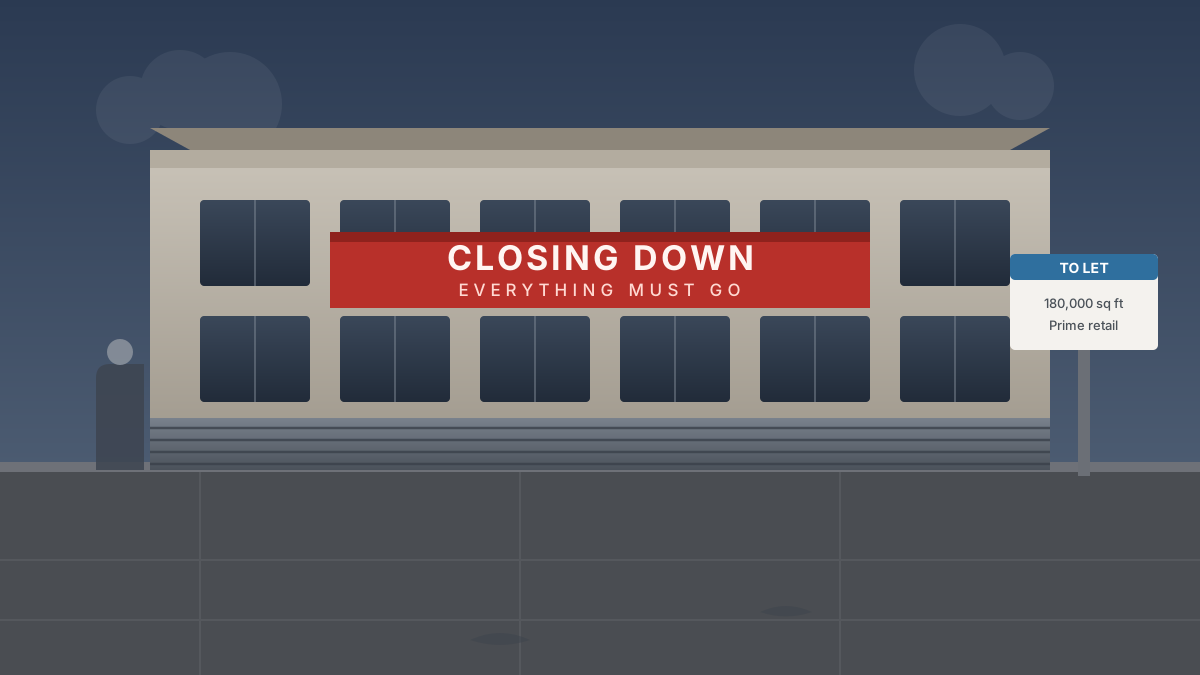
The scale of it
| Figure | Value | What it means |
|---|---|---|
| Age of the business | 242 years | Founded 1778. One of the oldest retail names on the UK high street when it failed. |
| Pre-tax loss, 2018 | £491.5m | The record loss that started the sequence, reported the year before the first administration. |
| Administrations filed | Two, 12 months apart | April 2019, then April 2020, the second a "light-touch" administration with management kept in place. |
| Stores at the end | 118 | Down from more than 200 at the chain’s peak. All closed. |
| Jobs lost | Around 12,000 | The workforce at the point of liquidation. 6,500 redundancies had already been made during 2020 alone. |
| What the brand sold for | £55m | Paid by Boohoo in January 2021 for the website, brand and customer data. No shops, no staff, no stock. |
What happened
Debenhams did not collapse suddenly. It filed for administration in April 2019, restructured, survived a court fight with its own landlords, and was still trading a year later when the pandemic shut every one of its shops. The second administration, in April 2020, was the one it did not come back from, and even then it took another eight months to run out of road.
The 2019 administration is the part most people have forgotten, and it is the more instructive one. A pre-tax loss of £491.5m in 2018 left the chain unable to service its debts. Rather than a sale, lenders took ownership through a pre-pack, which wiped out every existing shareholder, most visibly Mike Ashley, whose Sports Direct had spent years building a near-30% stake and lost the lot. The company voluntary arrangement that followed in May 2019 let Debenhams shut stores and force rent reductions on the landlords of the ones it kept. The landlords went to the High Court to stop it, and in September 2019 they lost.
So Debenhams entered 2020 smaller, leaner, still heavily indebted, and entirely dependent on footfall. On 23 March every store closed. The April 2020 administration was structured as "light-touch", meaning existing management stayed in day-to-day control while administrators looked for a buyer. That was a signal that the business was considered rescuable. Through the summer it was not rescued. In August, 2,500 more redundancies took the year’s job losses to around 6,500.
The autumn was a sequence of buyers arriving and leaving. Mukesh Ambani’s Reliance walked away. Mike Ashley came back with an improved offer in October. England went into a second lockdown on 5 November, removing the Christmas trading period any rescue would have been priced against. JD Sports entered exclusive talks on 24 November. On 30 November, Arcadia (Debenhams’ biggest concession partner, supplying the Topshop, Dorothy Perkins and Burton floorspace inside its stores) appointed administrators of its own. The following day, JD Sports withdrew, and administrators announced Debenhams would be wound down.
Two things are worth separating here, because they are usually run together. The business failed in December 2020. The brand was sold in January 2021. Those are not the same event, and the second one saved nobody’s job.
How it unfolded
| Date | What happened |
|---|---|
| 2018 | Debenhams reports a record pre-tax loss of £491.5m. |
| April 2019 | First administration. The chain is taken over by a consortium of its lenders, wiping out shareholders, including Mike Ashley’s Sports Direct, which had built a near-30% stake. |
| May 2019 | Creditors approve a company voluntary arrangement allowing store closures and rent cuts. |
| September 2019 | Debenhams wins a High Court challenge brought by landlords against the CVA. |
| 23 March 2020 | All stores close under the first coronavirus lockdown. |
| April 2020 | Second administration, this time "light-touch": existing management stays in day-to-day control. |
| August 2020 | A further 2,500 redundancies announced, taking job losses since the start of the pandemic to about 6,500. |
| September 2020 | Administrators begin drawing up contingency liquidation plans while a sale is still being sought. |
| 18 October 2020 | Mike Ashley tables an improved bid after Mukesh Ambani’s Reliance walks away. |
| 5 November 2020 | England’s second lockdown begins, taking out the Christmas trading the rescue depended on. |
| 24 November 2020 | JD Sports enters exclusive talks. It is the last serious bidder for the business as a going concern. |
| 30 November 2020 | Arcadia, Debenhams’ largest concession operator, appoints its own administrators. |
| 1 December 2020 | JD Sports pulls out. Administrators announce Debenhams will be wound down. |
| 25 January 2021 | Boohoo buys the brand, website and customer database for £55m. The shops are not included. |
| May 2021 | The last Debenhams stores finish trading and close for good. |
What happened since
The name is now the parent company. Boohoo Group, which paid £55m for the Debenhams brand and website in January 2021, spent four years discovering that the acquisition was worth more than the business that bought it. In March 2025 it put a resolution to shareholders to rename the whole group Debenhams Group. The vote failed: it needed two-thirds and got just over 62%, with Frasers Group voting its 413 million shares against. Boohoo went ahead in every practical sense anyway: the London ticker changed to DEBS on 31 March 2025, and the company trades and reports as Debenhams Group while the registered legal entity is still boohoo group plc.
The model that failed on the high street is now a marketplace. Debenhams today does not buy stock and sell it to you. Third-party brands list on the platform and Debenhams books only its commission as revenue. That is why the headline numbers look strange: for the year ended 28 February 2026, revenue fell 24.7% to £917m while adjusted EBITDA rose 34.6% to £53.3m and the pre-tax loss narrowed by 69.2%, from £352.5m to £108.6m. Marketplace gross merchandise value reached £620.4m, up 14.9%, and now accounts for 34.1% of group GMV against 23.3% the year before.
It is still losing money, and it is still not a shop. A £108.6m pre-tax loss is a big improvement on £352.5m and is not the same as profitability. Management has said it is aiming at £100m-plus of EBITDA eventually and upgraded profit guidance twice during 2026, with chief executive Dan Finley pointing to a reset cost base, consolidated warehousing, a completed technology replatform and exited onerous costs. What none of that restores is the thing the 2021 story was about: 118 buildings and roughly 12,000 jobs. Those went in December 2020 and have not come back.
This section was last brought up to date on 1 September 2026.
Where this came from
- City A.M. Dated timeline of the collapse, from the 2018 loss through to the December 2020 liquidation decision
- InternetRetailing Contemporaneous report of the Boohoo purchase: what was and was not included, store count and workforce · January 2021
- BusinessCloud The March 2025 shareholder vote on the rename, and the FY26 results figures quoted above · 2025 and 2026
- Retail Gazette Where the marketplace model stood in mid-2026 and what management is targeting · July 2026
What we could not check
- The 12,000 figure is the workforce at the point of liquidation, as cited by the administrators. Reported totals for jobs lost across the whole 2019–2021 sequence vary between sources depending on whether concession staff and earlier redundancies are counted, so treat any single number as approximate.
- We have not seen the administrators’ final reports to creditors, so the recovery paid to each class of creditor is not stated here.
- Debenhams Group’s FY26 figures are the company’s own reported and adjusted numbers. "Adjusted EBITDA" is a measure the company defines itself, and it is not the same as profit.
- Litigation brought by former Debenhams staff over the redundancy process has continued after the liquidation. We have not verified its current status and this page makes no claim about it.
Company figures are as reported by the businesses themselves or their administrators. Where two sources disagree, this page says so rather than picking one.