
Why Buy a Shower Pump? First Check You Are Allowed One
If your hot water comes from a combi or a mains-pressure unvented cylinder, a shower pump is not a purchase you can make. The law gets there before the plumber does. If you do have a cold tank in the loft and a hot cylinder, two facts decide whether you end up happy, and neither of them is the bar rating on the box.
The short answer
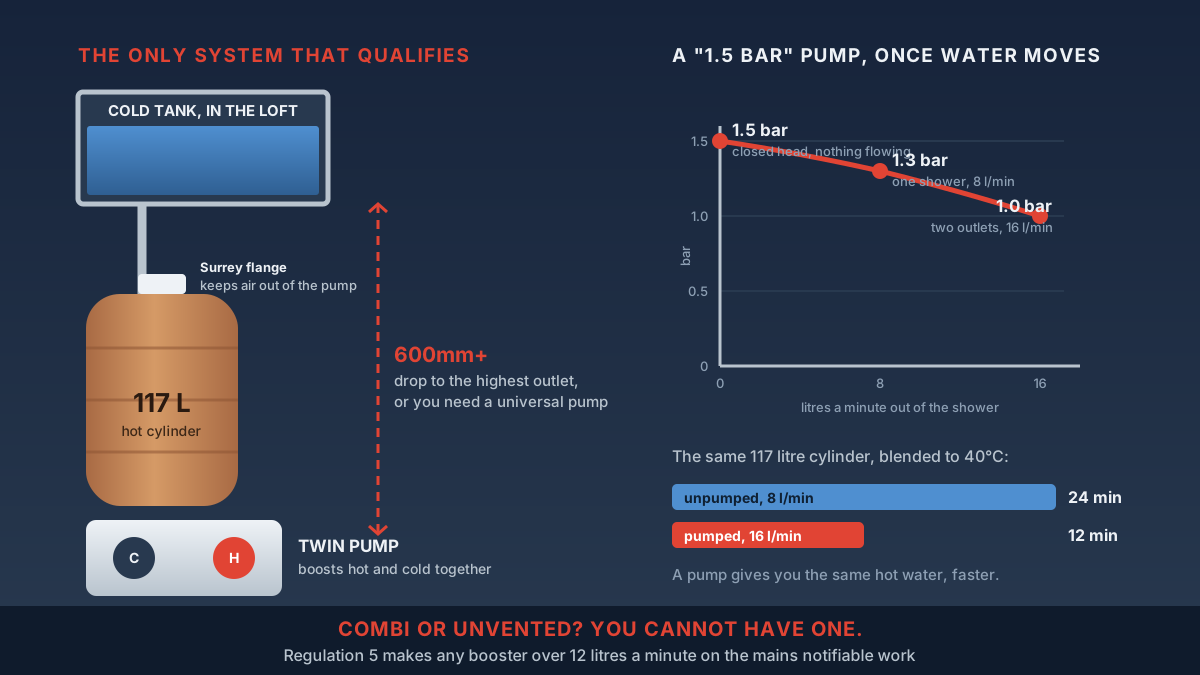
Start with the go/no-go, because most people fail it. A shower pump is for a gravity-fed system: a cold water tank in the loft, a hot water cylinder in the airing cupboard. If you have a combi boiler, or an unvented cylinder running at mains pressure, you cannot simply have one fitted. Under Regulation 5 of the Water Supply (Water Fittings) Regulations 1999, a pump or booster drawing more than 12 litres a minute that is connected, directly or indirectly, to a supply pipe is notifiable work, and your water company has to consent to it before the job starts. Screwfix list the Stuart Turner Showermate with the same warning in plain words: it “must not be connected directly to mains water supply”.
If you are on the mains, the realistic answer is a 12 litre a minute booster, not a shower pump. Salamander’s HomeBoost is built to sit exactly under that line, and the company describes 12 l/min as “the maximum flow rate allowed to be pumped directly from the mains”. It gives 1.6 bar, runs at 46 dBA with a Quiet Mark, holds WRAS approval 2212082 and a three-year warranty, and only steps in when the incoming flow is between 3 and 12 litres a minute. It will not turn a weak mains supply into a power shower, and nothing legal will.
If you do have the tank and the cylinder, ignore the number on the box. The bar rating is measured at closed head, with no water flowing at all. Stuart Turner’s own data sheet for the Monsoon Universal twin shows the “1.5 bar” model giving 1.3 bar at 9 litres a minute and 0.8 bar at 18. Salamander’s CT50 Xtra: 1.5 bar closed, 1.3 at 8 l/min, 1.0 at 16. Both manufacturers publish this. No retailer leads with it.
Then look at your cylinder, because it decides how long the good shower lasts. A standard 900 × 450mm vented copper cylinder holds 117 litres. Blend that from 60°C down to a 40°C shower and you have roughly 195 litres of usable water. That is about twelve minutes at 16 litres a minute, against about twenty-four unpumped. A bigger pump does not give you more hot water. It gives you the same hot water, faster.
What the bar rating delivers once water is flowing
| Pump | Rating on the box | One shower running | Two outlets running | Screwfix price |
|---|---|---|---|---|
| Salamander CT50+ Xtra twin positive head only · 455W · 52.5 dBA · IPX3 · 60°C max · 3yr | 1.5 bar (closed head) | 1.3 bar at 8 l/min | 1.0 bar at 16 l/min | £149.99 |
| Stuart Turner Monsoon Universal twin 1.5 355W at this rating · 65°C · IPX4 · 5yr | 1.5 bar (closed head) | 1.3 bar at 9 l/min | 0.8 bar at 18 l/min | not on the list we checked |
| Stuart Turner Monsoon Universal twin 3.0 655W at this rating · 65°C · IPX4 · 5yr | 3.0 bar (closed head) | 2.5 bar at 9 l/min | 1.9 bar at 18 l/min | £679.99 |
| Grundfos 98950216 twin | 1.5 bar | not published | not published | £134.99 |
| Salamander HomeBoost mains-fed homes · 46 dBA · WRAS 2212082 · 3yr | 1.6 bar | 12 l/min ceiling, the legal maximum straight off the mains | not applicable | no current retail price found |
Flow-versus-pressure figures are the manufacturers’ own published data: Stuart Turner’s Monsoon Universal twin data sheet and Salamander’s CT50 Xtra product page. Prices are from the Screwfix shower pump category page, 84 products listed, checked on 2 September 2026. We found no published flow curve for the Grundfos pumps, so we make no claim about what their bar rating delivers in use.
First, can you even have one?
This is the question the old version of this page never asked, and it is the one that sends most readers away without spending anything. A shower pump takes water that is already sitting in your loft tank and your hot cylinder and pushes it harder. It has nothing to hold back if the water is already arriving at mains pressure.
The law, not the plumber’s opinion
Regulation 5 of the Water Supply (Water Fittings) Regulations 1999 makes “a pump or booster drawing more than 12 litres per minute, connected directly or indirectly to a supply pipe” notifiable work. Notifiable means your water undertaker has to be told and has to consent before the work starts. That is the reason combi and unvented homes cannot simply have a shower pump fitted, and it is why Screwfix put the warning on the product listing itself: the Showermate “must not be connected directly to mains water supply”.
How to tell in thirty seconds
Look in the loft. A plastic cold water tank up there, feeding a copper cylinder in the airing cupboard, means a gravity system and a shower pump is on the table. No tank, and a boiler that heats water on demand, means a combi, with nothing to pump. A cylinder with no tank above it, wrapped in a factory-fitted jacket with a pressure relief pipe running outside, is unvented and already at mains pressure.
If you are on the mains, the answer is a 12 litre ceiling
There is a legal product for mains-fed homes, and it is deliberately modest. Salamander’s HomeBoost is designed to sit under the Regulation 5 line: the company describes 12 litres a minute as “the maximum flow rate allowed to be pumped directly from the mains”, and the unit will not exceed it. It gives 1.6 bar, runs at 46 dBA with a Quiet Mark certification, carries WRAS approval 2212082 and a three-year warranty, and only cuts in when the incoming flow sits between 3 and 12 litres a minute.
Read those thresholds carefully, because they are the whole product. Below 3 l/min coming in, there is not enough for it to work with. Above 12, you did not need it. What it fixes is the middle case: a mains supply that is adequate but limp. What it will not do is give you the 16 to 18 litres a minute a twin gravity pump manages, because nobody is allowed to sell you that off the mains.
We found no current retail price for the HomeBoost; the retailer page we checked did not show one. Treat any figure you are quoted as the one to check.
The bar rating is measured with the water switched off
This is the single most useful thing on this page. The bar figure in the product name is closed head pressure, measured with the outlet shut and nothing flowing. The moment you open a shower valve, it drops, and it drops further the more water you draw.
Both major manufacturers publish the real curve. Stuart Turner’s Monsoon Universal twin data sheet gives, for the “1.5 bar” model, 1.3 bar at 9 litres a minute (their one-shower column) and 0.8 bar at 18 litres a minute, their two-shower column. The 3.0 bar model in the same table gives 2.5 and 1.9. Salamander’s CT50 Xtra is rated 1.5 bar closed, 1.3 at 8 litres a minute and 1.0 at 16.
So a “1.5 bar” pump running two outlets at once is delivering roughly half its name. That is not a defect and nobody is lying. It is simply what the number means. But it explains the most common disappointment: a pump bought on its rating that feels fine alone and feeble when someone runs a tap.
And do not compare across brands on flow, either
The Stuart Turner Showermate TP S quotes a maximum flow of “32 Ltr/min”. Salamander’s 16 l/min is a two-outlet running figure. Those are different measurements of different things and putting them in one column tells you nothing. We have kept them apart above for that reason.
The cylinder, not the pump, decides how long it lasts
A pump moves water. It does not make any. The size of your hot cylinder is what sets the length of the shower, and pumping shortens it.
The standard vented copper cylinder is 900 × 450mm and holds 117 litres. Stored at 60°C and blended down to a 40°C shower with 10°C mains cold, that is about 195 litres of usable water. Divide it up:
- Unpumped, at about 8 litres a minute: roughly 24 minutes.
- Pumped, at 16 l/min: roughly 12 minutes.
- Pumped hard, at 18 l/min: roughly 11 minutes.
And that is for the whole household, not per person. The second shower of the morning is getting whatever the first one left.
Screwfix say the same thing from the other direction
Their own guide warns against putting a 3.0 bar or higher pump on a small cylinder, because the hot water “will run out very quickly”. The Hot Water Association’s sizing guidance points the same way: allow 35 to 45 litres of cylinder per occupant, on the basis that a shower uses about 18 litres of 40°C water a minute and a bath about 100 litres. A four-person house on those numbers wants 140 to 180 litres of cylinder. The standard 117 is already short before you add a pump.
If you want a long, strong shower, the sensible order of work is a bigger cylinder first and a pump second. Buying the 3.0 bar pump instead is how people end up with a magnificent four minutes.
Positive, negative or universal, and how to find out which you are
Pumps are sold by the kind of head they need, and buying the wrong one is an expensive mistake because the cheap version simply will not start.
Positive head
Needs gravity to push water through the pump before it kicks in. The requirement is more than 600mm of drop from the base of the cold tank to the highest outlet, plus a natural flow at that outlet. Salamander’s test is a litre jug filled in under 30 seconds, which is 2 litres a minute.
Negative head, and the universal pumps that cover both
If the outlet is close to, level with or above the tank, gravity is not going to do it, and you need a universal or negative-head pump. Stuart Turner say their universal pumps “will function even if there is no flow through the pump or shower head due to gravity alone”. A universal works in either situation, so it is the safe choice when you are unsure. It is not cheap, though. At the same 1.5 bar rating we found a Grundfos twin universal at £383.99 against £134.99 for the positive-head twin. That is roughly £250 for the certainty.
Where the sources disagree, and what we would do
The 600mm drop is agreed by Salamander, Screwfix and Toolstation alike. The minimum flow is not: Salamander and Toolstation both say 2 litres a minute, Screwfix says 0.6. No published standard settles it, so we are not going to pick a winner. Use the minimum printed in the manual of the pump you are buying, and if your measurement is anywhere near the line, buy the universal.
Worth measuring your existing flow before any of this. Toolstation’s thresholds: under 10 litres a minute is low, 10 to 15 is acceptable, 15 and above is good. If you are already at 15, the pump is solving a problem you do not have.
Single or twin, and the mixer trap
A twin pump boosts hot and cold together and is what almost every shower wants. A single pump boosts one. The trap is what happens when you pump one side and not the other.
Salamander are explicit that single positive-head pumps “are not suitable to use on mixer showers and taps due to a potential imbalance within the mixer”. Pump the hot only, leave the cold on mains, and the mixer is being fed two very different pressures. That is exactly how you get a shower that swings between scalding and freezing when someone flushes a loo.
They are equally clear about the fix: if you are pumping hot water that will be mixed with mains cold, you want a universal single, not a positive one, because mains pressure can push back towards the pump. If in any doubt, fit a twin.
The flange nobody puts in the quote
Air collects at the dome of a hot cylinder. Take the pump feed off the standard outlet and the pump drinks that air. Salamander warn that the result is temperature swings, noise and “accelerated degrading of the pump’s internal workings, leading to an eventual leak”. A flange moves the take-off so the pump gets water instead.
- Surrey flange: top entry. Screws into the cylinder dome. The easier fit.
- Essex flange: side entry. Means drilling the cylinder, which means draining it down first. That is a labour cost, and it belongs in the original quote.
Is it compulsory? The manufacturers differ in emphasis rather than substance. Stuart Turner say a flange is “recommended but not essential” where the pump sits below the crown of the cylinder, but that “a flange must always be used” above it. Some Salamander warranties require one outright, with an exception for their CT range where the pump is at the cylinder base and the cold tank is at least 1.2m above it.
The part is £44.99 for Salamander’s top-entry S flange. Against a £400 installation and a pump warranty that may hinge on it, arguing about it is false economy.
Noise: the numbers do not agree, and it matters
A shower pump usually lives in an airing cupboard, which is usually next to a bedroom. This is the specification people regret ignoring, and it is also the one where our sources contradict each other outright.
Manufacturers publish figures in the low fifties: Salamander’s CT50 Xtra at 52.5 dBA, the Stuart Turner Showermate TP S at 53 dBA measured at one metre. Screwfix’s own buying guide says standard pumps run “upwards of 70 to 80 decibels”, with quiet models “from as little as 48”.
That is a gap of twenty-five decibels or more, and nothing we found reconciles it. A retailer guide describing a whole market and a manufacturer quoting one product under test conditions are not measuring the same thing, but we cannot tell you which figure you will hear at seven in the morning. What we would do: assume the retailer is closer to the truth in a real airing cupboard, and treat anti-vibration mounting and a solid cupboard door as part of the job rather than an extra.
What a pumped shower really costs you
The electricity to run a shower pump is trivial. The hot water it gets through is not, and this is the running cost nobody mentions when they sell you one.
Our assumptions, printed so you can argue with them. 1.163 watt-hours to lift one litre of water by one degree; cold in at 10°C; shower at 40°C; a gas boiler running at 90% efficiency. Ofgem’s current cap rates, 26.11p to 26.32p per kWh for electricity and 7.33p for gas. None of this is a manufacturer figure. It is our arithmetic, and it moves with your boiler and your tariff.
- Eight minutes at 8 litres a minute (64 litres) is 18.2p of gas.
- Eight minutes at 16 litres a minute (128 litres) is 36.4p of gas, plus about 1.6p of pump electricity. Call it 38p.
- Two showers a day, every day: about £133 a year becomes about £277.
So the pump costs roughly £145 a year to enjoy, and almost none of that is the pump. It is water you are heating and sending down the drain twice as fast. That is a perfectly reasonable thing to spend money on if the shower is genuinely miserable, but it should be a decision, not a surprise.
One more thing worth weighing before you spend £400 on plumbing: if the problem is one shower rather than the whole house, an electric shower runs off the cold mains and sidesteps all of this. We looked at what that trade-off feels like in our Triton Aspirante review.
What it costs to buy, to fit, and every time you use it
| What | Figure | What it means |
|---|---|---|
| The pump itself | £134.99 to £679.99 | Screwfix category page, 2 September 2026, 84 products listed. Grundfos 98950216 twin 1.5 bar £134.99; Salamander CT50+ Xtra twin 1.5 £149.99; Showermate TP S £149.99; Stuart Turner Showermate Standard twin 1.5 £154.99; Grundfos 98950217 twin 2.0 £169.99; Salamander CT75+ Xtra twin 2.0 £265.99; Monsoon Standard twin 3.0 £519.99; Monsoon Universal twin 3.0 £679.99. |
| The negative-head premium | roughly £250 | A Grundfos twin universal 1.5 bar was £383.99 against £134.99 for the positive-head twin at the same rating. If your outlet is close to, level with or above the cold tank, that is what the universal version costs you. |
| Surrey flange | £44.99 | Salamander top-entry S flange. Small money, and the part most likely to be missing from a cheap quote. An Essex flange goes in the side of the cylinder, which means drilling it and draining it down. Get that in the original quote, not as an extra on the day. |
| Supply and fit | about £400 | Checkatrade cost guide, updated June 2026. A plumber is around £50 an hour and the job is three hours upwards. |
| A power shower instead | £200 to £500 | Checkatrade again: average labour £350, three to six hours. Power showers use 8 to 12 litres a minute, which is the flow a pumped gravity shower gives you anyway. |
| Electricity to run the pump | about 1.6p a shower | An eight-minute shower at 16 litres a minute. At the October price cap rate of 26.11p to 26.32p per kWh, the pump is not the cost. It is close to a rounding error. |
| The hot water it uses | 18.2p → 36.4p | The same eight minutes at 8 l/min uses 64 litres and 18.2p of gas; at 16 l/min it uses 128 litres and 36.4p. Pumping does not heat water more efficiently; it just gets through twice as much of it. |
| Two showers a day, for a year | £133 → £277 | Including the pump electricity, 38.0p a shower against 18.2p. Our arithmetic, on the assumptions printed below, not a manufacturer or supplier figure. |
| Gas and electricity rates used | 7.33p gas, 26.32p electricity | Ofgem price cap. 1 July to 30 September 2026: electricity 26.11p per kWh plus 57.19p a day, gas 7.33p plus 29.04p a day. From 1 October to 31 December 2026: electricity 26.32p plus 54.83p a day, gas 7.97p plus 29.68p a day. That is a cap of £1,723, up 4%. The gas figures above use the current 7.33p rate, so they rise slightly in October. |
Before you buy, check
- Is there a cold water tank in the loft? No tank, or an unvented mains-pressure cylinder, and a shower pump is not legally available to you. Ask about a 12 l/min mains booster instead.
- Measure your existing flow. Under 10 litres a minute is low, 10 to 15 is acceptable, 15 and above is good on Toolstation’s thresholds. If you are already at 15, do not buy a pump.
- Measure the drop from the base of the cold tank to the highest outlet. More than 600mm and a natural flow at that outlet means a positive-head pump will work. Less, and you need a universal.
- Do the jug test. A litre in under 30 seconds at the outlet is the 2 l/min Salamander want. Screwfix say 0.6 l/min is enough, so use the minimum in your own pump’s manual, and if it is close, buy the universal.
- Twin, not single, for any mixer shower. If you are pumping hot into a mains cold mixer, Salamander say that wants a universal single, never a positive one.
- Ask what the bar figure is at your flow rate, not at closed head. If the seller cannot answer, the manufacturer’s data sheet can.
- Size the cylinder before the pump. 35 to 45 litres per occupant is the Hot Water Association’s guide. A 117-litre cylinder and a 3.0 bar pump is a short shower with excellent pressure.
- Is a flange in the quote, and which one? An Essex flange means draining the cylinder down. Check whether your pump’s warranty requires one.
- Where is it going, and what is on the other side of that wall? Manufacturers quote low fifties in decibels, Screwfix say 70 to 80 for standard pumps. Budget for anti-vibration mounting.
- Ask the electrician whether the install is Part P notifiable. It depends on the location and the supply, and no general answer exists that we found.
- Get the whole job quoted: around £400 supply and fit on Checkatrade’s June 2026 guide, a plumber at about £50 an hour, three hours upwards, plus the flange.
Where this came from
- legislation.gov.uk: SI 1999/1148 Water Supply (Water Fittings) Regulations 1999, Regulation 5: the 12 litres a minute threshold above which a pump or booster on a supply pipe is notifiable work · checked 2 September 2026
- WaterRegsUK The plain-English guidance on what notifiable means and which water undertaker has to consent · checked 2 September 2026
- Salamander Pumps: CT50 Xtra product page The flow-versus-pressure figures for the CT50 Xtra, plus its wattage, noise rating, IP rating, temperature limit and warranty · checked 2 September 2026
- Salamander Pumps: choosing the right product Positive and negative head, the 600mm drop, the litre-jug flow test and the 2 litres a minute minimum · checked 2 September 2026
- Salamander Pumps: flange guidance Why a flange is needed, the air-ingestion damage warning, Surrey versus Essex, and the warranty conditions including the CT-range exception · checked 2 September 2026
- Salamander Pumps: single versus twin That single positive-head pumps are unsuitable for mixer showers, and that pumped hot mixed with mains cold wants a universal single · checked 2 September 2026
- Salamander HomeBoost The 12 l/min mains ceiling described as the legal maximum, 1.6 bar, 46 dBA and Quiet Mark, WRAS approval 2212082, three-year warranty and the 3 to 12 l/min operating window · checked 2 September 2026
- Stuart Turner Monsoon Universal twin data sheet (PDF) The one-shower and two-shower flow-versus-pressure columns for the 1.5 and 3.0 bar models, plus wattages, IPX4, 65°C limit and maximum inlet static head · checked 2 September 2026
- Stuart Turner FAQs That universal pumps function with no gravity flow at all, and when a flange is recommended rather than mandatory · checked 2 September 2026
- Screwfix: guide to shower pumps, category page and Showermate TP S listing The 70 to 80 decibel claim, the 0.6 l/min minimum, the warning against high-bar pumps on small cylinders, all the prices, and the “must not be connected directly to mains water supply” note · checked 2 September 2026
- Toolstation: shower pump buying guide The flow-test thresholds (under 10 low, 10 to 15 acceptable, 15 plus good) and the 2 l/min positive-head minimum · checked 2 September 2026
- Hot Water Association Cylinder sizing at 35 to 45 litres per occupant, a shower at about 18 litres of 40°C water a minute and a bath at about 100 litres · checked 2 September 2026
- Ofgem The price cap unit rates behind every running-cost figure here, for July to September and October to December 2026 · checked 2 September 2026
- Checkatrade Shower pump supply and fit at around £400, plumber hourly rates and job length, and the power shower installation comparison · cost guide updated June 2026
What we could not check
- We found no flow-versus-pressure curve for any Grundfos pump, so we make no claim at all about what their bar ratings deliver in use. They are in the price table and nowhere else.
- The twelve-minute cylinder figure is optimistic. It assumes you get all 117 litres out at a usable temperature, and in reality stratification and the last of the tank cooling will take some off. We could not find published derating data for a standard vented cylinder, so treat it as a ceiling rather than a promise.
- We do not know what your water company will charge or allow. We were unable to establish what any undertaker charges to consider a Regulation 5 notification, or on what grounds it would consent to a booster above 12 litres a minute. Ask yours before assuming either.
- Whether a shower pump install is Part P notifiable is not settled here. It depends on the location and the electrical supply. Put the question to the electrician doing the work.
- No current retail price for the Salamander HomeBoost. The retailer page we checked returned none, so we have left the cell empty rather than guess.
- The noise figures are unreconciled. Screwfix say 70 to 80 decibels for standard pumps; Salamander and Stuart Turner publish 52.5 and 53 dBA for their own. We could not find a common test basis, so both are shown and neither is endorsed.
- The positive-head minimum flow is disputed. Salamander and Toolstation say 2 litres a minute, Screwfix says 0.6. We found no published standard, so the page tells you to use your own pump’s manual. The 600mm drop is agreed by all three.
- The Showermate TP S maximum flow of 32 litres a minute is not comparable with Salamander’s 16 l/min two-outlet figure. Different measurement, different conditions. We have deliberately kept them out of the same column.
- We have no independent, sample-sized reliability data for any UK shower pump brand, so this page makes no durability claim about any of them. Warranty lengths are the manufacturers’ own and are the only proxy we would trust.
- The running costs are our arithmetic on stated assumptions, not a sourced figure. They use the July to September gas rate, so they rise slightly from 1 October when gas goes to 7.97p per kWh.
- We did not test any of these pumps. Everything above is manufacturers’ published data, retailer and trade guidance, and legislation.
- Prices were taken from one retailer’s category page on one day. Eighty-four products were listed; we have shown the spread rather than every model, and none of it is a recommendation of that retailer over another.
Prices and specifications change constantly. Every figure here is dated, so check the one in front of you before spending.