
The Five Electric Showers Worth Buying, and What the kW Number Buys You
A bigger kW does not give you a hotter shower or a cheaper one. It gives you more litres a minute, and only if your cold main and your cable can carry it. Triton’s own figures put a 9.5 kW shower at 6.2 litres a minute in summer and 3.7 in winter. We priced five units at Screwfix, Toolstation and the makers direct on 8 September 2026, with buyer ratings and sample sizes, and worked out what each one costs to run.
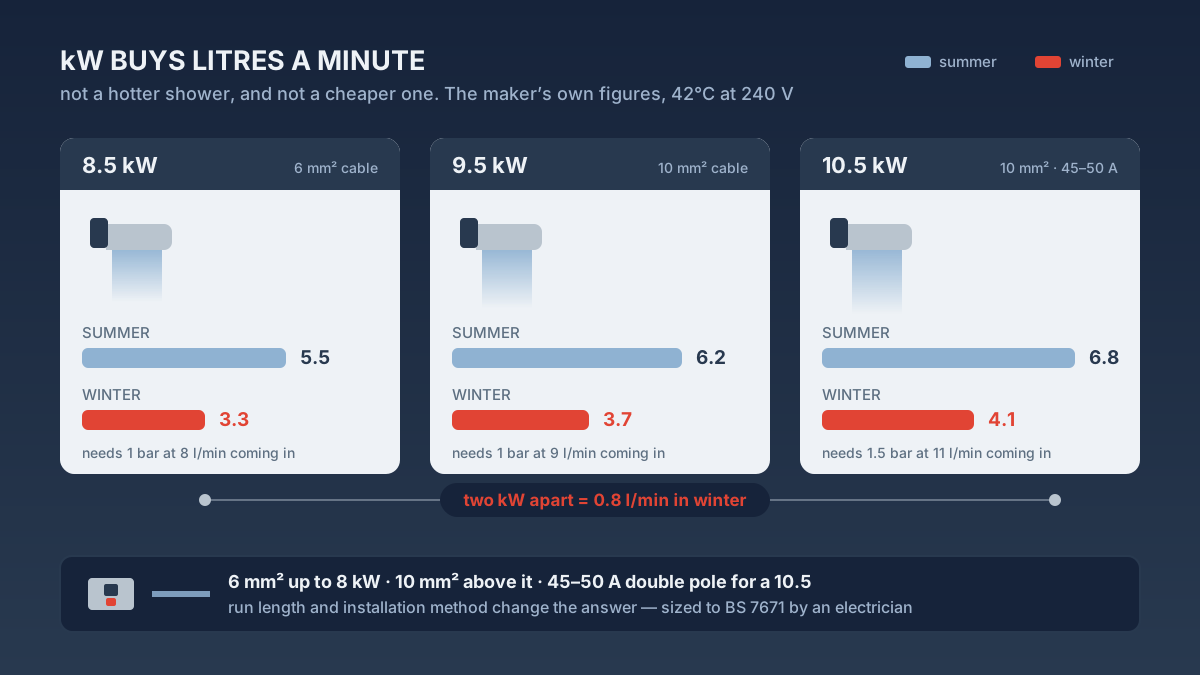
The short answer
Decision one: the kW you can have is decided by your cable and your cold main, not by what you fancy. Triton’s own guidance is that a shower up to 8 kW typically takes 6 mm² cable and anything above 8 kW takes 10 mm², and that a 10.5 kW unit “typically requires a 45–50-amp double-pole circuit breaker”. They also say plainly that the length of the run and the installation method change the answer, that the circuit must meet BS 7671, and that in England and Wales the job falls under Part P and “must be carried out or certified by a competent person”. So: get an electrician to tell you what your circuit will carry before you choose a shower, not after. If you are replacing an 8.5 kW unit fed by 6 mm² cable, moving to 10.5 kW is a rewire and a consumer-unit job, not a swap.
The water side has a limit too. Triton require 1 bar at 8 litres a minute for a 7–8.5 kW shower, 1 bar at 9 l/min for 9–9.5 kW, and 1.5 bar at 11 l/min for a 10.5 kW unit to give full performance. A weak main that cannot feed the bigger heater will not be rescued by buying it.
Decision two: kW buys litres a minute, and nothing else. On Triton’s own figures (42°C at 240 V), the whole 8.5-to-10.5 kW range is worth about 1.3 l/min in summer and 0.8 l/min in winter. That is real, but smaller than the marketing implies, and dwarfed by the season: every rating loses roughly 40% of its flow between July and January. Nor does kW change your bill per litre. All three ratings land within a rounding error of each other, about 0.67p of electricity per litre in summer and 1.12p in winter on the current Ofgem cap. An electric shower is a resistive heater; there is no efficiency to shop for.
Decision three: thermostatic costs about £115, on the same shower. Screwfix sell the Triton T80 Easi-Fit+ 9.5 kW at £114.99 manual and £229.99 thermostatic: same model, same 3.7–6.2 l/min, same two-year guarantee. That is the clearest price on thermostatic control anywhere in the range. Worth it in a house with small children or an elderly relative, where somebody flushing a loo turning the shower cold-then-scalding is a real risk. In a two-adult household, 749 buyers gave the manual one 4.5 out of 5.
Our pick, if you want one sentence. The Triton T80 Easi-Fit+ 9.5 kW at £114.99 from Screwfix: it is the cheapest of the big-name replacement units with a serious sample size behind it, it fits where the old one was, and 9.5 kW is the rating most British bathrooms are already wired for.
Five electric showers we would buy, and one we would not
| Shower | Price and retailer | kW | Flow (min / max) | Buyer rating | Our verdict |
|---|---|---|---|---|---|
| Triton T80 Easi-Fit+ 9.5 kW manual, White/Chrome | £114.99 Screwfix £160.99 Toolstation; from £166 Triton direct | 9.5 | 3.7 l/min at 1 bar / 6.2 l/min | 4.5/5 from 749 Screwfix | The one to buy. Six cable entries, swivel water inlet, built for replacing whatever is on the wall. |
| Triton Enrich 9.5 kW manual, White | £89.99 Screwfix Black/Chrome £109.99 | 9.5 | 3.7 / 6.2 l/min | 4.5/5 from 1,531 Screwfix | The cheap one that is not a gamble. Single spray, 70 mm head, biggest sample size in the roundup. |
| Triton T80 Easi-Fit+ 9.5 kW Thermostatic | £229.99 Screwfix | 9.5 | 3.7 / 6.2 l/min | 4.3/5 from 97 Screwfix | Buy it for the people in the house, not the shower. Identical performance to the £114.99 unit; you are buying temperature safety. |
| Mira Sport Max with Airboost 9 kW White/Chrome | £249.99 Screwfix 10.8 kW version £269.99 | 9.0 | 4 l/min at 0.7 bar / 8 l/min | 4.6/5 from 119 Screwfix | The best-feeling shower here, at a price. Airboost adds air, not water; Mira claim “up to 30%” more flow with no extra water used. |
| Gainsborough Slim Duo 9.5 kW White | £119.99 Screwfix the 10.5 kW is £89.99 | 9.5 | 1.7 l/min at 0.9 bar / 10 l/min | 4.4/5 from only 9 Screwfix | Slim, cheap, thinly evidenced. Starts at the lowest pressure of any unit here. Nine reviews is not a verdict. |
| Aqualisa Lumi+ Mirrored 9.5 kW the one we would not buy | £439.99 Screwfix £558.06 on Aqualisa’s own site | 9.5 | 2.7 l/min at 0.85 bar / 11 l/min | No reviews at all | Four times the Enrich for the same 9.5 kW. Manual control, not thermostatic. You are paying for a mirrored fascia and a light strip. |
Every price, rating and flow figure read off the retailer’s own product page on 8 September 2026. Flow figures are the retailer’s “delivers X at Y bar” minimum and quoted maximum, which is not the same measurement as Triton’s seasonal table further down, so do not compare the two columns. All six carry a two-year manufacturer’s guarantee; Mira’s requires registration. Screwfix pool reviews across colour and kW variants of the same model, so the Mira 9 kW and 10.8 kW share one score of 4.6/5 from 119, and the Gainsborough 9.5 and 10.5 kW share 4.4/5 from 9.
What the 2021 version of this page promised, and why the number has moved
The old post ran under the title “The top 5 electric showers to buy in 2021 under £180”. We have kept the address because it is indexed, and we have thrown the rest away. We should be straight about one thing: the old body text is no longer readable. The page still appears in search listings, but every attempt to fetch it returned a 404, and the Wayback Machine holds no snapshot of it. So we are correcting the promise in the title rather than the claims underneath it, because the claims underneath it are gone.
That £180 ceiling no longer describes the market. Of the six units we priced on 8 September 2026, three come in under £180 (£89.99, £114.99, £119.99) and three do not (£229.99, £249.99, £439.99). A budget cap is a worse organising idea than it was in 2021 anyway, because the thing that decides your price is no longer the badge. It is whether you want thermostatic control, which on one and the same Triton adds £115.
One more 2021-era assumption worth killing: a list of five “best” showers is not a shopping decision. Four of the six units here are 9.5 kW and three deliver an identical 3.7–6.2 l/min. What separates them is control type, fascia, sample size and price, not performance.
The wiring: what “like-for-like replacement” means
An electric shower is one of the heaviest single loads in a house. At 9.5 kW on a nominal 230 V supply it draws over 40 amps, more than a cooker and more than anything else on a ring final. This is why the wiring, not the shower, is the real project.
The cable and the breaker
Triton’s own knowledge base gives the starting point: up to 8 kW, typically 6 mm²; above 8 kW, typically 10 mm², with a 10.5 kW unit “typically” on a 45–50 A double-pole circuit breaker. They are careful to call these “starting-point guidelines” and to say that the correct answer depends on the length of the cable run and the method of installation. A cable clipped to a joist and a cable buried in insulation are not the same cable, electrically. The circuit has to satisfy BS 7671, the IET Wiring Regulations, and the sizing is the electrician’s calculation, not a number you read off a blog.
It is notifiable work
In Triton’s own words, electric shower wiring “falls under Part P building regulations in England and Wales, which require the work to be carried out or certified by a competent person”. Use a registered electrician and keep the certificate, because that is the bit that matters when you sell the house.
What a genuine like-for-like swap looks like
The cheap install is the one where nothing about the circuit changes: same kW, same cable, same breaker, same isolator, and a unit whose cable and water entries line up with the old holes. That last part is a design feature you can shop for. Triton market the T80 Easi-Fit+ as “the ultimate replacement shower” with multiple cable and water entry points on both sides, a Swing-Fit terminal block for left- or right-hand cable and a Swivel-Fit inlet for left- or right-hand water; they name the T80Z Fast-Fit or T80 Pro-Fit as the replacement for all previous T80 models, and say it often suits other makers’ units too.
Note what Triton do not promise. Their own installation-service questionnaire asks whether “your old shower has the same kW rating as your new shower” before it will quote you a fitting price. Change the rating and you are outside like-for-like, whatever the box says about easy fitting.
8.5 against 9.5 against 10.5 kW, on the manufacturer’s own numbers
This is the one comparison the category is sold on, and Triton are the only one of the three big brands who publish it as numbers. Their table is stated at a 42°C shower temperature on a 240 V supply:
Litres a minute, by season
8.5 kW: summer 5.5, autumn 4.1, winter 3.3.
9.5 kW: summer 6.2, autumn 4.5, winter 3.7.
10.5 kW: summer 6.8, autumn 5.0, winter 4.1.
Read the winter column first, because that is when a weak shower is miserable. The entire two-kilowatt spread buys you 0.8 of a litre a minute in January. The same shower loses about 40% of its summer flow by then, which is a far bigger effect than anything you choose in the shop. Triton put it plainly: colder incoming water means the shower “has to work harder”, and “the higher the kW rating, the more efficiently it can heat water—resulting in a stronger flow even when the incoming water is colder”. We would quibble with the word efficiently (a 10.5 kW heater is not more efficient, it is simply bigger), but the direction is right.
Mira publish nothing comparable
Before you compare brands: Mira do not publish litres a minute against kW at all. Their kW explainer calls 7.5 and 8.5 kW suitable for “a smaller water tank or an unreliable water supply” with a “gentler flow”, and 9.0 to 10.8 kW a “consistently greater flow” for a “luxury experience” or “long, thick hair”. That is a description, not a specification, which is why our table quotes retailer minimum-and-maximum figures and this section quotes Triton’s, and never mixes the two.
Where the supply caps you anyway
Triton require, for full performance: 1 bar at 8 l/min for 7–8.5 kW, 1 bar at 9 l/min for 9 and 9.5 kW, 1.5 bar at 11 l/min for 10.5 kW, with reduced performance from as little as 0.5 bar at 8 l/min. If your main is below the 10.5 kW threshold, buying the 10.5 kW unit turns a wiring bill into nothing at all. Run a jug test at the bathroom cold tap first, and if the answer disappoints, read our piece on shower pumps, with the warning that an electric shower is normally mains-fed, and a mains booster is regulated work with a hard 12 l/min ceiling.
Thermostatic or not: the £115 question
You will read, in more than one buying guide, that this is a non-issue. Expert Reviews’ electric shower round-up (Stuart Andrews, 18 September 2024) says “most if not all electric showers have some form of thermostatic control”. The market disagrees with that, hard, and the disagreement has a price tag. Screwfix list the Triton T80 Easi-Fit+ 9.5 kW in two versions: £114.99 with a manual rotary control, and £229.99 described as “Thermostatic Temperature Control”. Identical kW, identical published flow. If thermostatic were standard, that £115 would not exist.
Several units in between hold a middle position and it is worth naming. Triton describe the Aspirante’s control as “Stabilised” rather than thermostatic. The Aqualisa Lumi+, at £439.99, is a manual rotary control with a low-pressure indicator and automatic water-failure shutdown. Those are safety features, not temperature regulation. Paying more does not automatically buy you thermostatic.
Who should pay the £115
A thermostatic unit holds the outlet temperature when the incoming cold pressure changes: the loo flushing, the washing machine filling, the kitchen tap running. In a two-adult household with nothing else drawing water at shower time, a manual control with a decent stabiliser is what most people are happily using: 749 Screwfix buyers rated the manual T80 at 4.5 out of 5. In a household with young children, anyone elderly, or anyone who cannot react quickly to a sudden scald, we would pay it and not think about it again.
The five, one at a time
Triton T80 Easi-Fit+ 9.5 kW manual: £114.99, our pick
3.7 l/min at 1 bar rising to 6.2, two-year guarantee, 4.5/5 from 749 Screwfix buyers. It exists to replace something: six cable entry points, Swing-Fit terminal block, Swivel-Fit water inlet, and what Triton call a “generous footprint for replacement installations”, the polite phrase for covering the holes the last one left. Watch the price, because this is the widest spread in the roundup: £114.99 at Screwfix (from a stated £134.99), £160.99 at Toolstation and from £166 direct from Triton. A £51 gap on the same box, on one morning. Check all three.
Triton Enrich 9.5 kW: £89.99, the cheap one that is not a gamble
Same 3.7–6.2 l/min, same two-year guarantee, and the strongest evidence on the page: 4.5/5 from 1,531 Screwfix buyers. You give up spray patterns (one setting, a 70 mm round head) and some fitting flexibility, though it still has multiple cable and water entries, a 1 m stainless hose and a riser rail. The black/chrome version is £109.99 for the same shower in a different coat. If your circuit already suits 9.5 kW and you just want hot water, stop here and save twenty-five pounds.
Triton T80 Easi-Fit+ 9.5 kW Thermostatic: £229.99
Everything said above about the manual version, plus thermostatic control, minus a bit of confidence in the sample: 4.3/5 from 97 against the manual’s 749. The lower score across a smaller sample is not evidence the thermostatic unit is worse. It is a different, smaller pool of buyers. Our verdict: this is a household-safety purchase. If nobody in your house is at risk from a sudden temperature swing, the £115 is better spent on the electrician.
Mira Sport Max with Airboost 9 kW: £249.99, the best-feeling one
4.6/5 from 119 Screwfix buyers, the highest score here, and a minimum of 4 l/min at 0.7 bar (the lowest pressure threshold of anything we would recommend), rising to 8 l/min. Airboost is the selling point and Mira are clear about what it is: air induction into the water stream, “increasing the flow of water by up to 30% without using any more water”. Read that literally. It makes 9 kW of heated water feel like more water; it does not heat more water, and it does not belong in the same column as litres a minute. The guarantee needs registering. The 10.8 kW version is £269.99, and Screwfix publishing identical 4–8 l/min figures for both ratings tells you those numbers are the product family’s, not the heater’s.
Gainsborough Slim Duo 9.5 kW: £119.99, slim but thinly evidenced
The lowest published starting point in the roundup: 1.7 l/min at 0.9 bar, with a quoted maximum of 10 l/min, plus automatic water-failure shutdown and a two-year guarantee. The case for it is the slim profile in a tight cubicle. The case against is the evidence: 4.4/5 from nine reviews, pooled across colours and kW variants. Nine people is not a verdict, and we will not pretend otherwise. One genuinely odd thing to know: the 10.5 kW Slim Duo is £89.99, thirty pounds cheaper than the 9.5 kW. The kW ladder is not a price ladder, and if your circuit is certified for 10.5 kW that is the version to look at.
Aqualisa Lumi+ Mirrored 9.5 kW: £439.99, and no
Here because it is what happens when you shop on looks. It is manual, not thermostatic; it runs 2.7 l/min at 0.85 bar up to 11 l/min; it carries the same two-year guarantee as the £89.99 Enrich; and on the day we checked it had no customer reviews at all. Aqualisa’s own site showed £558.06 against Screwfix’s £439.99. We cannot reconcile those, so we are printing both. The mirrored fascia and light strip are real, and some people will want them. Just know you are paying roughly £350 for the fascia, and the thermostatic T80 instead would leave you £210 in hand.
What the ratings are worth, and where Bristan went
Retailer stars are pooled
Screwfix aggregate reviews across variants. The Mira 9 and 10.8 kW share one score of 4.6/5 from 119; the Gainsborough 9.5 and 10.5 kW share 4.4/5 from 9; the Enrich white and black share 4.5/5 from 1,531. None of these tells you about the specific kW you are buying. They are still the best evidence going, which is why we print the sample size every time.
Company scores are not product scores
On Trustpilot, 8 September 2026: Mira Showers 4.8/5 from 15,236 against Triton Showers 3.9/5 from 3,378. A large, real gap, but a gap in customer service and warranty handling, not in showers. Weigh it if you expect to need the guarantee; do not let it override 1,531 buyers rating a specific unit 4.5 out of 5. And note that Toolstation showed 124 reviews on the T80 Easi-Fit+, Triton’s own site 5,990, the Aspirante page 922 and the T80Z page a Feefo badge over 2,647, with no numeric average we could read on any of them. A count without a score is not a rating, so we have not quoted one.
Bristan: we could not price one
Bristan make electric showers and they are widely listed on smaller sites, so we went looking for a current big-shed price. Screwfix’s Bristan electric shower filter returned zero products, and the Bristan Cheer 9.5 kW page returned an HTTP 410 “no longer available”, the code for a line that has gone for good, not a temporary out-of-stock. Bristan’s own filtered listing returned nothing we could read. We will not conclude from that that Bristan have left the category; we are telling you what we found. If you are shown a Bristan electric shower, ask about spares availability first.
What one of these costs to run
The sums below are ours, and the assumptions are printed so you can disagree with them. The electricity rate is the Ofgem price cap for 1 July to 30 September 2026: 26.11p per kWh, plus a 57.19p daily standing charge you pay whether you shower or not. From 1 October to 31 December 2026 the electricity rate rises to 26.32p with a 54.83p standing charge, and the headline cap goes to £1,723, up 4%, so add about 1% to every figure here from October.
An electric shower is a resistive heater, so the arithmetic is simple: kWh = kW × minutes ÷ 60. There are no losses to argue about and no efficiency rating to shop for.
The comparison that surprises people
Against a gas combi feeding a mixer shower, the electric shower is dearer per litre and cheaper per shower. Per litre of 40°C water from 10°C mains, a 90% efficient gas boiler at 7.33p/kWh costs about 0.28p; the electric shower costs about 0.67p in summer. But the electric shower physically cannot deliver the volume: 8 minutes at an autumn 4.5 l/min is 36 litres against 64 litres for the same 8 minutes on a mixer at 8 l/min. Thirty-three pence against eighteen. You pay a premium per litre for the privilege of not heating a tank. It is exactly the right trade in a second bathroom, an en suite, or a flat where the boiler is a long pipe run away.
Running costs at the current price cap
| What | Figure | What it means |
|---|---|---|
| Electricity rate used | 26.11p per kWh | Ofgem price cap, 1 July to 30 September 2026, direct debit, England, Scotland and Wales. Standing charge 57.19p a day. From 1 October it is 26.32p and 54.83p. |
| A 9.5 kW shower, 8 minutes | 33.1p | 1.27 kWh. About 36 litres at Triton’s autumn flow figure of 4.5 l/min, or 50 litres in summer. |
| An 8.5 kW shower, 8 minutes | 29.6p | 1.13 kWh, but only about 33 litres at the autumn figure. Cheaper per shower because it is a smaller shower. |
| A 10.5 kW shower, 8 minutes | 36.6p | 1.40 kWh, about 40 litres. Three and a half pence more than the 9.5 kW for four more litres. |
| The same 9.5 kW, 15 minutes | 62.0p | The single biggest variable on this page is how long you stand there. Seven extra minutes costs more than the difference between any two models. |
| Cost per litre of hot water | 0.67p summer, 1.12p winter | Our arithmetic from Triton’s seasonal flow table. Within a rounding error, the figure is identical for 8.5, 9.5 and 10.5 kW. kW buys flow, not efficiency. |
| Two 8-minute showers a day, a year | about £241 | 9.5 kW, 730 showers, 925 kWh at 26.11p. Excludes the standing charge, which you pay regardless. |
| The same water from a gas combi | about 0.28p a litre | Our arithmetic, not sourced: 1.163 Wh per litre per degree, 10°C mains to 40°C, 90% efficient boiler, gas at 7.33p/kWh. Same assumptions as our shower pump page, so the two are comparable. |
Before you buy, check
- What will your circuit carry? Ask an electrician before you shop, not after. Triton’s starting points are 6 mm² up to 8 kW and 10 mm² above it, 45–50 A for a 10.5 kW, but run length and installation method change the answer, and BS 7671 decides it.
- Is it the same kW as the old one? If yes, this is a swap. If no, it is a rewire, and possibly a consumer-unit job. Triton’s own installation service asks this question before quoting.
- Have you measured the cold supply? 1 bar and 9 l/min for a 9.5 kW; 1.5 bar and 11 l/min for a 10.5 kW. Below that you have bought a heater you cannot feed.
- Do you need thermostatic? On the same Triton it is a £115 decision. Children, elderly relatives, or a bathroom that goes cold every time the loo flushes? Pay it. Otherwise do not.
- Does the new unit cover the old holes? Multiple cable and water entries and a generous footprint are what turn a fitting job into a half-hour job. Check the entry positions against what is on your wall.
- How many reviews is the score built on? 1,531 and 9 are both printed as stars out of five. Only one of them means anything.
- Have you checked three prices? The same T80 Easi-Fit+ was £114.99, £160.99 and £166 at three sellers on one morning.
- Is the guarantee conditional? All six here are two years; Mira’s requires registration, and Triton’s two years is quoted as parts and labour.
Where this came from
- Triton Showers:8.5kW vs 9.5kW vs 10.5kW electric showers The seasonal flow table at 42°C on 240V: 5.5/4.1/3.3, 6.2/4.5/3.7 and 6.8/5.0/4.1 litres a minute · checked 8 September 2026
- Triton Showers:what size electric cable is required for an electric shower The 6mm² / 10mm² cable guidance, the 45–50A breaker figure for a 10.5kW, and the BS 7671 and Part P wording · checked 8 September 2026
- Triton Showers:minimum water pressure and flow rate The supply thresholds for full performance: 1 bar at 8 l/min for 7–8.5kW, 1 bar at 9 l/min for 9–9.5kW, 1.5 bar at 11 l/min for 10.5kW, and reduced performance from 0.5 bar at 8 l/min · checked 8 September 2026
- Screwfix:Triton T80 Easi-Fit+ 9.5kW manual Price £114.99 (from £134.99), 3.7–6.2 l/min, two-year guarantee, 4.5/5 from 749 reviews, replacement-footprint claim · checked 8 September 2026
- Screwfix:Triton T80 Easi-Fit+ 9.5kW Thermostatic Price £229.99, identical 3.7–6.2 l/min, the “Thermostatic Temperature Control” wording, 4.3/5 from 97 reviews · checked 8 September 2026
- Screwfix:Triton Enrich White 9.5kW manual Price £89.99, 3.7–6.2 l/min, two-year guarantee, 4.5/5 from 1,531 reviews, single spray, 70mm head · checked 8 September 2026
- Screwfix:Triton 9.5kW electric shower listing The twenty-model price and rating list, including the Enrich black at £109.99 and the T70gsi+ at £119.99 (4.5/5 from 219) · checked 8 September 2026
- Screwfix:Mira Sport Max with Airboost 9kW Price £249.99, 4–8 l/min, the “up to 30%” Airboost wording, guarantee subject to registration, 4.6/5 from 119 reviews · checked 8 September 2026
- Screwfix:Gainsborough Slim Duo White 9.5kW Price £119.99, 1.7–10 l/min, automatic water failure shutdown, 4.4/5 from 9 reviews · checked 8 September 2026
- Screwfix:Gainsborough Slim Duo White 10.5kW Price £89.99 (thirty pounds less than the 9.5kW), with 1.7 to 11 l/min and the same nine-review pool · checked 8 September 2026
- Screwfix:Aqualisa Lumi+ Mirrored 9.5kW Price £439.99, 2.7–11 l/min, manual rotary control not thermostatic, and no customer reviews · checked 8 September 2026
- Toolstation: Triton T80 EasiFit+ 9.5kW The second retailer price of £160.99, six cable entry points, and 124 reviews with no readable numeric average · checked 8 September 2026
- Triton Showers:T80 Easi-Fit Plus product page The maker’s own “from £166.00”, the 7.5–10.5kW range, and the installation questionnaire asking whether the old shower has the same kW rating · checked 8 September 2026
- Triton Showers:Aspirante product page From £189.00 in 8.5 and 9.5kW, a “Stabilised” rather than thermostatic control, 922 reviews with no readable score · checked 8 September 2026
- Triton Showers:electric showers knowledge base The T80Z Fast-Fit or T80 Pro-Fit named as the replacement for all previous T80 models and often other makers’ units · checked 8 September 2026
- Mira Showers:electric shower kW ratings explained That Mira publish no litres-a-minute figure against kW, and their qualitative descriptions of 7.5–8.5kW and 9.0–10.8kW · checked 8 September 2026
- Mira Showers:Airboost technology explained Mira’s own wording: air induction increasing flow “by up to 30% giving the feeling of more water without actually using any extra water at all” · checked 8 September 2026
- Aqualisa: Lumi+ product page The manufacturer’s own listed price of £558.06 against Screwfix’s £439.99, and the mirrored fascia and light strip description · checked 8 September 2026
- Ofgem: energy price cap unit rates and standing charges Electricity 26.11p/kWh and 57.19p a day to 30 September 2026; 26.32p and 54.83p from 1 October; gas 7.33p then 7.97p · checked 8 September 2026
- Trustpilot: Triton Showers and Mira Showers Company TrustScores, not product scores: Triton 3.9 out of 5 from 3,378 reviews, Mira 4.8 out of 5 from 15,236 · checked 8 September 2026
- Expert Reviews: the best electric showers to buy Stuart Andrews: the claim that “most if not all electric showers have some form of thermostatic control”, which the £115 Screwfix price gap contradicts · published 18 September 2024, checked 8 September 2026
What we could not check
- We were unable to read the old 2021 page. The title survives in search listings (“the top 5 electric showers to buy in 2021 under £180”) but both URL forms returned 404 and the Wayback Machine holds no snapshot. We have corrected the premise, not the individual claims, because we never saw them.
- Nobody has tested any of these showers, us included. Every flow figure on this page is the manufacturer’s or the retailer’s. We found no independent laboratory measurement of electric shower flow anywhere, and the one buying guide we read (Expert Reviews) gives no sign of hands-on testing either.
- Two flow measurements are in circulation and they are not the same thing. Triton’s seasonal table (42°C at 240 V) and the retailers’ “delivers X l/min at Y bar” minimum are different tests. We have kept them in separate places and we cannot convert between them.
- Mira publish no litres-a-minute figure against kW at all, so our 8.5 / 9.5 / 10.5 comparison rests on one manufacturer. We have no second source for those numbers.
- Aqualisa’s own price and Screwfix’s do not agree: £558.06 against £439.99 for the Lumi+ 9.5 kW. We do not know whether the higher figure is an RRP, a bundle or stale. Both are printed above.
- We found no way to price a Bristan electric shower at a mainstream retailer. Screwfix’s Bristan electric filter returned nothing and the Bristan Cheer 9.5 kW page returned HTTP 410. Whether Bristan have withdrawn the range, or Screwfix have simply stopped stocking it, we do not know.
- Retailer star ratings are pooled across variants, so none is a rating of the exact kW and colour you buy, and we do not know how a reviewer is verified.
- The cable and breaker figures are Triton’s starting points, not your answer. We have not read BS 7671 itself (it is a paid standard), and the correct cable for your installation is a calculation an electrician makes on site.
- No sample-sized reliability data exists for any of these units, so nothing here is a claim about how long one lasts.
- The running costs are our arithmetic, on printed assumptions, not anyone’s published data. The gas comparison assumes 10°C mains, a 40°C shower and a 90% efficient boiler, and real boilers and real mains vary.
- Every price is from 8 September 2026 and at least two were promotional. The same T80 moved £51 between three sellers on one day.
Prices and specifications change constantly. Every figure here is dated, so check the one in front of you before spending.