
DeWalt DCD796 Review: Whose 70Nm, and Which Battery the Weight Includes
B&Q sells the DCD796 in at least nine different configurations, and the number on the box changes depending on which one you buy. Two people who have actually drilled with it agree it has more power than most home users need. The figures underneath the headline are where the buying decision really sits — so we have set out which of them come from DeWalt, which come from a test, and which come from a warehouse scale.
Where the reviews line up
Three very different sets of eyes: Homebuilding & Renovating, where Garry Martin put a DCD796 kit through steel, masonry and timber over an extended test; DIY Garden, which ran it on a comparison rig against other drills and timed the holes; and the Screwfix Community Forum, where a DIYer asking whether to buy this or the cheaper DCD778 got seventeen replies from people who own DeWalt kit. Alongside them sit the rating blocks at Power Tool World and Screwfix — 4.8/5 from 265 and 4.7/5 from 9.
They agree on three things. The power is not in question. DIY Garden timed 45 seconds through 3 mm steel plate, 15 seconds for a 5 mm hole in brick, and called thirty holes through 38 mm timber “almost too easy”. Homebuilding found the 70 Nm first-gear figure held up with larger bits and in hammer mode on engineering brick. The battery connection is the recurring gripe, and it is the one criticism both testers make independently: Homebuilding says the battery wobbles, DIY Garden says it “rattles about”. And it is loud. DeWalt’s own manual declares 89 dB sound pressure; DIY Garden put it at 100 dB in use and marked it down for it. Either way, wear ear defenders.
The forum adds the thing neither tester will tell you, because it is not about the drill: buy two batteries, not one big one. Several posters make the same point in different words — a 5.0Ah pack that dies mid-job is worse than two 2.0Ah packs, and the lighter packs are what you will want when you are drilling above your head.
What nobody has done is compare the B&Q kits against each other. That is the real decision here. The same drill is sold at B&Q bare, with 2 × 2.0Ah, with 2 × 4.0Ah, with 2 × 5.0Ah, with an 85-piece bit set, and paired with an impact driver. The tool inside is identical. Everything you are choosing between is batteries, a box and accessories — so price the batteries, not the drill.
The three reviews this summary is built from
- Homebuilding & Renovating and DIY GardenTwo hands-on tests, one with timed holes on a comparison rig. The only sources here that measured anything.
- Screwfix Community ForumThread 245617, started 11 October 2021, seventeen replies. DIYers arguing about batteries, not marketing.
- Power Tool World & Screwfix4.8/5 from 265 ratings and 4.7/5 from 9 — on pages that sell the drill.
Before the review: 70Nm and 27Nm are the same drill
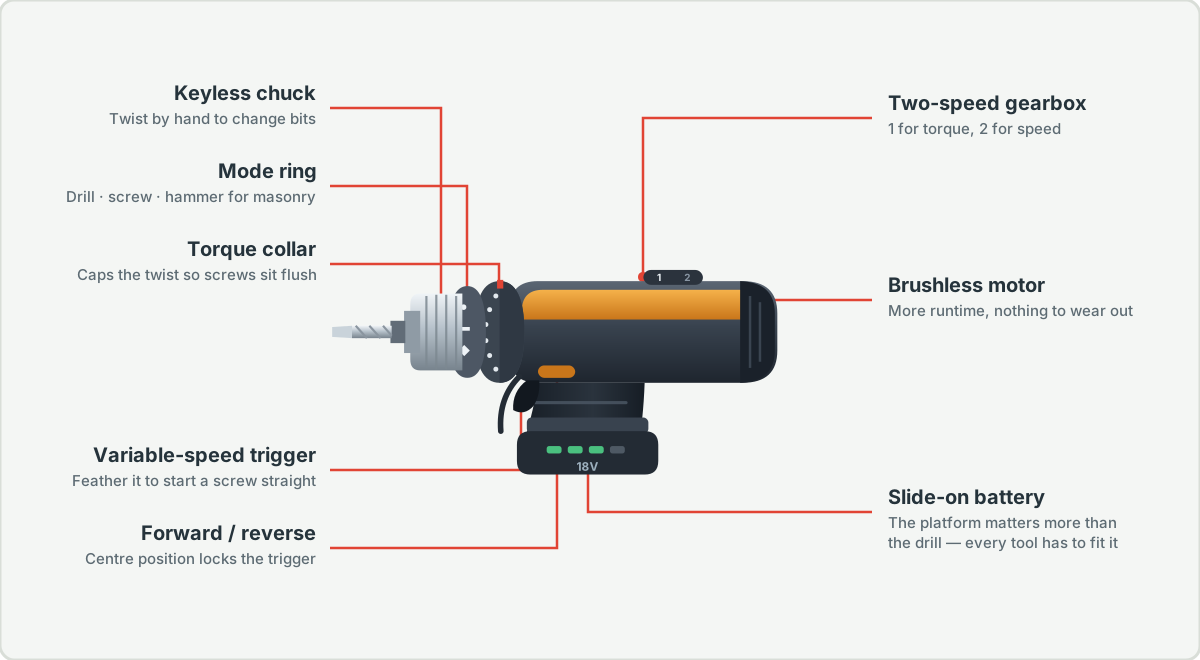
You will see the DCD796 listed at 70 Nm in some places and 27 Nm in others, and both are DeWalt’s own numbers. The manual gives maximum torque in hard applications as 70 Nm and in soft applications as 27 Nm. RS Online manages to publish both on its own site — 27 Nm against the Euro-plug listing and 70 Nm against the British 3-pin one. Nothing is different inside. If a listing quotes 27 Nm it is not a weaker drill, it is a different line of the same table.
Specification at a glance
| Spec | Figure | The trap |
|---|---|---|
| Maximum torque | 70 Nm hard · 27 Nm soft | DeWalt’s own figure, not a measured one. Nobody we found has put this drill on a torque rig. Both numbers come from DeWalt’s manual; retailers pick whichever suits the listing |
| Torque collar settings | 15 positions plus drill and hammer | DeWalt’s manual and ITS both say 15. DIY Garden says 13 and marks the drill down for it. We have not counted the ring ourselves |
| No-load speed | 0–550 rpm (1st) · 0–2,000 rpm (2nd) | Consistent everywhere. This is the figure to compare against the DCD778’s 1,750 rpm |
| Hammer rate | 0–9,350 bpm (1st) · 0–34,000 bpm (2nd) | Blows per minute, not impact energy. A combi drill is not an SDS hammer and 34,000 bpm does not make it one |
| Weight | 1.6 kg with a 1.5 or 2.0Ah pack · 1.8 kg with a 3.0, 4.0 or 5.0Ah pack | The single most-abused figure on the page. Power Tool World publishes both. DeWalt’s manual says 1,600 g against a 2.0Ah battery. Homebuilding weighed 1.8 kg with 5.0Ah. Screwfix says 1.9 kg “with battery” without saying which. ITS lists 4.6 kg, which is the boxed kit on a courier scale. DIY Garden says 1.3 kg, which is the bare body |
| Chuck | 13 mm keyless, all-metal, 1.5–13 mm capacity | Manual figure. “All-metal” refers to the chuck and the transmission housing, not the gear train alone |
| Drilling capacity | 40 mm wood · 13 mm steel · 13 mm masonry | DeWalt’s maxima, with a sharp bit in good material. Not a recommendation for repeat work at those sizes |
| Length | 190 mm | Manual. This is the whole point of the 796 over the bigger DCD996 — it fits between joists |
| Noise | 89 dB declared · around 100 dB measured | The two do not agree. 89 dB(A) is DeWalt’s declared sound pressure under EN 62841. DIY Garden reports about 100 dB in real use and scores noise 3.5/5 |
| Vibration | 11.5 m/s² drilling concrete · 2.5 m/s² drilling metal | Manual figures. The concrete number is high enough to matter for trade users under HAV rules; for an afternoon of shelves it does not |
| In the box at B&Q (DCD796P2-GB) | Drill, 2 × 5.0Ah XR batteries, multi-voltage charger, TSTAK kitbox | B&Q’s listing names the two batteries, charger and TSTAK box. DeWalt’s own page adds a belt hook and a magnetic bit holder. No drill or driver bits — Homebuilding flags their absence |
| Other B&Q configurations | Bare body; bare + TSTAK; bare + bag; 2 × 2.0Ah; 2 × 2.0Ah + 85-piece set; 2 × 4.0Ah; 4.0Ah + 5.0Ah; twin pack with DCF887 impact driver | Nine listings, one tool. Every price difference is batteries and a box |
| Warranty | 1 year, extending to 3 years on registration | DeWalt’s own wording. Screwfix’s listing says “1 Year Guarantee” and does not mention the extension — you have to register to get it |
| UK price, 18 September 2026 | £299.99 at Screwfix for the 2 × 5.0Ah kit · £155.99 at ITS for the 2 × 2.0Ah kit | B&Q’s price does not appear in the page its server sends, so we cannot quote it. The kit you compare decides the price far more than the shop does |
What the parts do
Homebuilding & Renovating and DIY Garden
These are the only two sources we found that put the drill in front of real material. Garry Martin drilled steel, aluminium and a range of timber densities, went through brick, block, concrete and engineering brick, and drove screws of several sizes across ordinary jobs — planters, flat-pack, shelving. His conclusion is measured rather than gushing: a solid drill with a long run-time that will stand up to demanding home and site conditions. He found the 70 Nm first-gear figure did real work with larger bits, particularly in hammer mode on masonry. He quotes the kit at 1.8 kg with a 5.0Ah battery and the price, in 2020, at £149.99.
DIY Garden’s value is that it timed things on a rig alongside other drills: 3 mm steel plate through in 45 seconds, a 5 mm hole in brick in 15, and thirty holes through 38 mm timber described as almost too easy. Its scores are performance 5/5 and power 5/5, dropping to 3.5/5 for noise and 4/5 for design. It is the source that puts a number on the noise — about 100 dB, against DeWalt’s declared 89 — and the one that warns about kickback: 70 Nm through a jammed bit will twist your wrist if you are holding the drill casually.
The agreement that matters is the complaint. Both testers, independently, dislike the battery-to-tool fit: Homebuilding describes the battery wobbling in the connection, DIY Garden that it rattles about. Two hands-on reviewers six years apart making the same observation is a real finding, not a bad sample. Neither tester recorded run-time in a repeatable way, and neither measured torque.
Watch: DeWalt DCD796 Review – Compact Beast or Overhyped Drill?
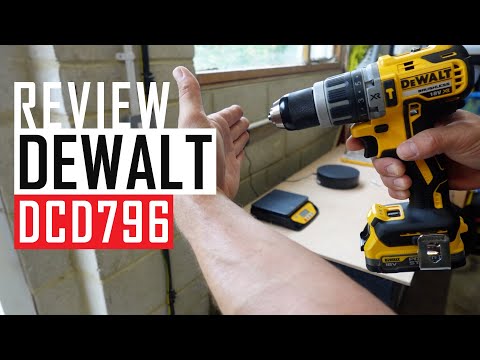
A review framed around exactly the question these two tests answer: whether the compact body gives anything away. We could not open YouTube from here, so we have not watched it — see the caveat box below.
Watch on YouTube ↗Screwfix Community Forum
This is the question most people buying a DCD796 are actually asking, posted by someone describing himself as a casual DIYer. The three options he priced in 2021 were a DCD778 with two 5.0Ah batteries at £153, the DCD796 with two 2.0Ah at £134, and the DCD796 with a single 5.0Ah at £135. He sets out the comparison cleanly: the 796 is smaller but more powerful, 70 Nm and up to 2,000 rpm against the 778’s 65 Nm and 1,750 rpm. His worry is the one that should worry you — that batteries bought separately later are expensive.
The seventeen replies barely discuss the drill. They converge, almost unanimously, on batteries. sparko69 argues one 5.0Ah is enough for a casual DIYer because it recharges in about half an hour. Tilt takes the other side and wins the thread: it does not matter how big the battery is if it runs out mid-job, so he would rather have a spare charged up. BiancoTheGiraffe puts it plainest — two smaller batteries rather than one big one. Several posters add that 4.0 to 5.0Ah packs suit sustained work but that a 1.5 to 3.0Ah pack is what you want overhead, where the extra half-kilo hangs off your wrist all afternoon.
Treat this for what it is: unverified opinion from people who mostly own other DeWalt tools rather than this specific model, on a forum run by a retailer. But the advice is consistent, it is not about brand loyalty, and it points straight at the B&Q decision — the kit with two 2.0Ah packs is a better buy for most homes than the kit with one large one, and the weight table above shows you why.
Watch: Dewalt dcd805 & dcd796 review #dewalt #hammerdrill #dewalttools #drill Wildwood Cottage Diary

An owner comparing the DCD796 with the newer DCD805 — the same generational question the forum keeps circling. Confirmed by search listing only; we could not open it.
Watch on YouTube ↗Power Tool World and Screwfix
Quote the sample size or the score means nothing. 4.8/5 from 265 ratings is a genuinely useful signal about a tool that has been on sale since 2016; 4.7/5 from 9 reviews is nine people, and one unhappy buyer would move it visibly. Both blocks sit on pages that sell the drill, and neither retailer publishes the distribution, so we can tell you what the average is and not what the unhappy minority said.
What the listings are better for is the specification itself, because this is where the contradictions surface. Power Tool World is the only retailer we found that publishes the weight honestly as two figures — 1.6 kg with a 1.5 or 2.0Ah battery, 1.8 kg with a 3.0, 4.0 or 5.0Ah — and the only one to give both torque figures and both impact rates. Screwfix gives a single weight of 1.9 kg “with battery” without naming the battery, which is the sort of line that ends up quoted back at you as though it were the tool’s weight. ITS, selling the 2 × 2.0Ah kit at £155.99 on 18 September 2026, lists the weight as 4.6 kg, which is the shipping carton.
One price we cannot make sense of: Power Tool World showed £62.95 including VAT for the bare DCD796N on the day we checked, against roughly £100 to £130 at most UK sellers for the same body-only tool. We are printing what the page said rather than quietly rounding it up, but check it on the listing before you count on it.
Watch: DeWALT Brushless Compact Drill Review - DCD796 /DCD791 Hammer Drill & Driver

The DCD796 against its drill-driver sibling, the DCD791 — the same body without hammer mode, which is the other choice B&Q puts in front of you. Confirmed by search listing only.
Watch on YouTube ↗Strengths and weak points
What holds up
- Power that both hands-on testers found surplus to home requirements: 45 seconds through 3 mm steel, 15 seconds for a hole in brick.
- 190 mm long, so it gets between joists and into cabinet carcasses where a full-size combi will not.
- Brushless motor, all-metal transmission and a 13 mm metal chuck at a mainstream price.
- Sits on the XR 18V battery platform, which B&Q, Screwfix and everyone else stocks — batteries will still be available in ten years.
- Three-year warranty if you register it, rather than the one year the listings advertise.
- 4.8/5 from 265 ratings at one retailer — a long sales history with no pattern of failure in it.
What people complain about
- The battery moves in the connection. Two independent testers, six years apart, both say so.
- Loud — around 100 dB measured against 89 dB declared. Ear defenders, not optional.
- Kickback if a bit grabs. 70 Nm demands a firm grip and the side handle when you are drilling masonry.
- No bits in the box at B&Q’s price, and the torque collar count is disputed (13 or 15).
- The 5.0Ah kit carries an extra 200 g in your hand all day, which is the wrong trade for overhead work.
- Nine near-identical B&Q listings make it genuinely hard to tell what you are paying for.
Who it actually suits
Buy it if you want one drill to cover shelves, flat-pack, fence posts and the occasional hole in a brick wall, and you would rather buy into a battery platform once than replace a cheap drill twice. For most homes the version to buy is the one with two smaller batteries rather than the one with a single large one — that is the forum’s near-unanimous advice, and the weight table explains it.
Look elsewhere if you are chasing raw power, in which case the DCD996 has three speeds and more of it; if you mainly want a light driver, in which case the hammer mode is weight you never use; or if your job is genuinely masonry, in which case buy an SDS hammer and stop asking a combi drill to be one. And if the £20-odd between this and the DCD778 is the whole question, the honest answer from the thread is that the 778 is the same kind of tool with slightly less of everything.
What we could not check
- The three videos. YouTube would not load for us at all — every attempt to open a watch page returned an HTTP 429 and our other route was blocked outright. All three videos on this page were confirmed by search listing: each exact watch URL appeared with the same title in two or more differently-worded searches on 18 September 2026. We have not watched any of them, and for two of them the channel name never appeared in a listing, so we have not guessed one.
- B&Q’s price. diy.com is rendered in the browser, so the page its server sends us contains the product, the specification and the box contents but no price. We have confirmed B&Q lists the DCD796 — nine configurations, checked 18 September 2026 — and left the price blank rather than lift it from a comparison site.
- Torque, measured. Nobody has put this drill on a torque rig and published the result. Every torque figure on this page, including the 70 Nm in the headline, is DeWalt’s.
- The torque-collar count. DeWalt’s manual and ITS say 15 settings; DIY Garden says 13 and criticises the drill for it. We cannot resolve it without the tool in front of us.
- Run-time. No source ran a repeatable battery test, so how many holes a 2.0Ah pack gives you is unanswered.
- Which battery Screwfix’s 1.9 kg refers to. The listing does not say, and it does not match either of Power Tool World’s two figures.
- Power Tool World’s £62.95. Well below every other price we saw for the bare tool. Printed as found, not relied on.
- Independent consumer-title testing. No Which? test, no national title. The two tests here are a specialist homebuilding magazine and a DIY website, which is not the same weight of evidence.
- Amazon’s rating block. Amazon’s robots file blocks us, so the largest pool of UK buyer ratings is not represented above.
Sources last checked 18 September 2026. Prices, kit contents and which configurations B&Q stocks all change — check the listing in front of you before ordering.