
Festival Tents for the UK: Buy One Berth Bigger, Then Check the Packed Length
Two decisions do almost all the work here, and neither of them is the waterproof rating. Buy a tent rated for one more person than you are taking, because a berth is a sleeping bag and nothing else. Then check how long the bag is when it is packed, because that, not the weight, decides whether you can carry it from the car park with your other hand free.
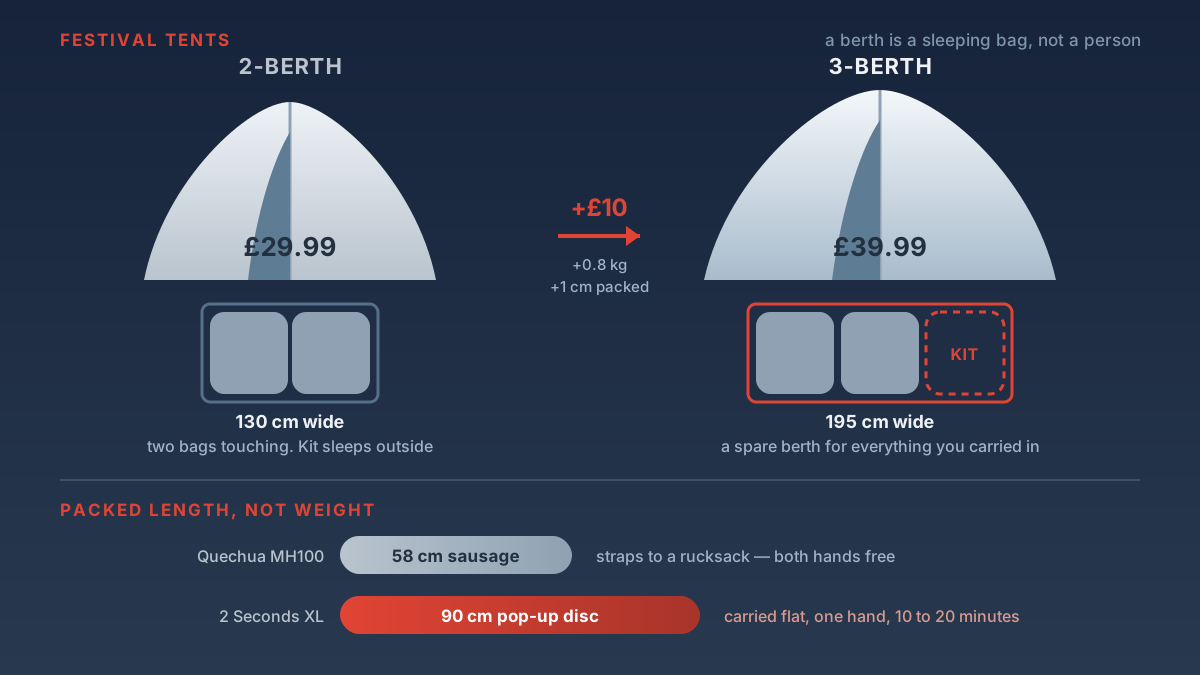
The short answer
Buy one berth more than your group. Manufacturers size tents by sleeping bags, not by people with kit. Decathlon publishes the Quechua MH100 sleeping area as “2 x 65 cm sleeping bags” per person. So a 2-berth for two people is literally two sleeping bags touching, with nowhere to put a rucksack, wet boots or anything else. Stepping up to the 3-berth costs £10 more and takes the sleeping area from 130 cm to 195 cm wide. The penalties are trivial: +0.8 kg, +1 cm of packed length, and +13 cm of headroom in your favour. There is no version of this where the extra tenner is the wrong call.
Then check the packed LENGTH, not the weight. Everything in this market weighs between about 2 and 4 kg, so weight tells you almost nothing. Shape tells you everything. A 58 cm sausage straps to the side of a rucksack and you walk in hands-free. A 90 cm pop-up disc cannot be strapped to anything. It gets carried flat, in one hand, for the entire walk from the car park to the campsite, which at Reading is 10 to 15 minutes to the main campsite and 15 to 20 to the quiet one.
Waterproofing is a distant third, because the whole budget market is the same. Everything sits at 2,000 to 3,000 mm. What separates a dry weekend from a wet one is the pitching order, the ground you pitch on, and whether the seams and pegs hold. The millimetre figure on the box is not it.
Our pick for most people: the Quechua MH100 3-person at £39.99 for two people. It is the cheapest way to buy the space, and it packs to 59 cm.
What you get for the money
| Tent | Price | Weight | Packed size | Waterproof | Sleeping area / peak height |
|---|---|---|---|---|---|
| Quechua MH100 2-person | £29.99 | 2.6 kg | 58 x 16 x 16 cm (15 L) | 2,000 mm fly / 2,400 mm groundsheet | 130 x 210 cm · 107 cm peak. 4.7/5 from 3,881 ratings on the selling page |
| Quechua MH100 3-person | £39.99 | 3.4 kg | 59 x 17 x 17 cm (17 L) | 2,000 mm fly / 2,400 mm groundsheet | 195 x 210 cm · 120 cm peak. 4.7/5 from 2,410 ratings |
| Vango Soul 200 | £54.99 (SRP £90, deep-discounted) | 2.17 kg | 52 x 15 cm diameter | 3,000 mm flysheet | Two berths. Quoted 7-minute pitch. Pitching order not stated by the retailer |
| Quechua 2 Seconds XL 3-person pop-up | RRP £139.99, currently £109.99 | 5.5 kg | 90 x 8 cm disc | 2,000 mm | Fastest to put up, hardest to put away (see below) |
| Vango Tay 200 | No price on the listing we used | 3.31 kg | Not listed | 3,000 mm | Two berths |
| Coleman Octagon Blackout | From £350 | 29.8 kg | Not listed | 4,500 mm | A family tent, listed here only to show what the top of the range weighs |
Prices and specifications checked on 3 September 2026, from the retailer and manufacturer listings named at the bottom of this page. The Vango Tay and Coleman figures come from the Camping and Caravanning Club listing, which does not give a packed size for either.
A berth is a sleeping bag, not a person
The single most useful thing on any budget tent listing is the sleeping-area description, and almost nobody reads it. Decathlon spells it out: the MH100 sleeping area is “2 x 65 cm sleeping bags”. That is the definition of a berth. Not a person with a rucksack, a coat, a pair of wellingtons and a bag of cans, but a 65 cm strip of floor, wide enough for a bag and nothing more.
So two people in a 2-berth are shoulder to shoulder across 130 cm, with every piece of kit either in the porch, outside, or on top of them. Two people in the 3-berth get 195 cm: one berth to sleep in each and a spare berth for everything you brought. The tent is the same length either way at 210 cm.
What the upgrade really costs you
This is the part that makes the decision easy. Going from the MH100 2-P to the 3-P costs £10, adds 0.8 kg, adds 1 cm to the packed length (58 cm to 59 cm) and two litres of packed volume, and gains you 13 cm of peak height, from 107 cm to 120 cm. That is the difference between kneeling and sitting up to get dressed on a wet Sunday morning.
Both tents carry the same rating on their selling pages, 4.7 out of 5, from 3,881 and 2,410 buyers respectively. We would not read too much into that beyond the obvious: nobody who bought the bigger one is complaining that it was too big.
Packed length is the number that decides your walk in
Weight is the specification everyone quotes and it is close to useless here, because the whole budget market is bunched together. The MH100 2-P is 2.6 kg. The 3-P is 3.4 kg. The Vango Soul 200 is 2.17 kg. The Vango Tay 200 is 3.31 kg. Nobody has ever abandoned a festival because of 800 grams.
Shape is what hurts. The MH100 packs to a 58 x 16 x 16 cm sausage; the Vango Soul 200 to 52 cm long and 15 cm across. Both of those strap to the side or the bottom of a rucksack and leave both your hands free for the cool box and the tickets. The 2 Seconds XL pop-up packs to a 90 x 8 cm disc. A disc that wide has nowhere to go: it gets carried flat against your body, in one hand, the whole way.
How long is the whole way? The Mosh Manual’s 2026 Reading guide puts the main campsite at 10 to 15 minutes’ walk from the stages and the quiet campsite at 15 to 20. That is each way, in a crowd, probably carrying everything else you own. Fifteen minutes with a disc under one arm is a genuinely different experience from fifteen minutes with a sausage strapped to your back.
The Coleman Octagon Blackout is in the table for scale only. At 29.8 kg and from £350, it is a family tent you drive to a pitch, not something you carry into a festival campsite.
The pop-up tax: two seconds up, considerably longer down
Pop-ups sell on the pitching time, and the pitching time is real. What is also real is the other end of the weekend. Reviewing the 2 Seconds XL for Live For The Outdoors in 2024, James Forrest found repacking “not quite so easy” and that it “can be a little bit of a struggle”. That is the pop-up’s real cost, and it is paid on Monday morning, hungover, in the rain, in front of a queue of people waiting to get out.
It matters more than it sounds, because a tent that is a struggle to repack is a tent that gets left standing. At £109.99 the 2 Seconds XL is more than three times the price of the MH100 2-person and roughly £22 a festival across five uses, and that is before you count the risk that it never makes it home.
For comparison, World of Camping quotes the Vango Soul 200 at a 7-minute pitch. Seven minutes is not two seconds, but it is also not a reason to pay an extra £55 and carry a 90 cm disc.
What the waterproof rating does and does not tell you
Hydrostatic head is quoted in millimetres and it sounds like a promise. It is a laboratory reading, taken on new, unused fabric, of how tall a column of water the material holds before it lets water through. It says nothing about the tent you are standing in on day three.
It is also not a differentiator at this end of the market. The two Quechuas are 2,000 mm on the fly and 2,400 mm on the groundsheet. The 2 Seconds XL is 2,000 mm. The Vango Soul 200 and the Vango Tay 200 are 3,000 mm. You have to get to a £350 Coleman before the number moves meaningfully, to 4,500 mm. Choosing between a 2,000 and a 3,000 on the millimetres alone is choosing between two tents that will both be fine or both be miserable for reasons that have nothing to do with millimetres.
Three things that decide whether you stay dry
1. The pitching order. This is the one nobody puts on the box. Writing about the MH100 Fresh & Black for Advnture in November 2022, Craig Taylor noted that the inner-first pitching design “poses problems in rain”, because you are putting the bedroom up, open to the sky, before the flysheet goes over it. If it is raining when you arrive, an inner-first tent gets wet inside during pitching, and no hydrostatic head figure saves you from that. A fly-first tent does not have the problem.
2. Where you pitch. The Mosh Manual is blunt about Reading: “The Reading site has flooded in past years.” Pitch on the highest ground you can find and accept the longer walk.
3. Seams and pegs. A taped seam that has been packed wet, and pegs that pull out of soft ground at 3am, will beat any fabric rating. Bring more pegs than the tent came with.
The tent you leave behind does not go to charity
The belief that abandoned tents get collected and donated is comfortable and wrong. The Association of Independent Festivals’ Take Your Tent Home campaign is direct about it: abandoned tents are taken to landfill. Not sorted, not donated, not recycled.
The AIF numbers, in full: an estimated 250,000 tents are left at UK music festivals a year. The average tent weighs 3.5 kg and is the plastic equivalent of 8,750 drinking straws or 250 pint cups. A 2018 AIF survey found 9.7% of attendees at member events had ditched a tent, around 875 tonnes of plastic. And 36% of abandoned tents were bought from Argos or Tesco, which tells you exactly which end of the market gets walked away from.
One important caveat on those figures: they are from 2019, so they are seven years old. They are still the numbers being quoted: NME’s Reading coverage on 1 September 2026 used the same 8,750-straws figure. That is a recycled estimate, not a fresh count of what happened at Reading this year, and we have not seen anyone publish one.
What festivals are doing about it in 2026
Reading ran a “No Tent Left Behind” scheme in 2026: show a packed tent to campsite staff and get a Co-op voucher. Organisers also published a “Campsite Clearance Commitment” pledging to clear and restore the site within two weeks, and their own line that “a tent left for general waste emits the same amount of CO2 as driving a petrol car for over 100 miles”. NME did not report how many tents were left, so we cannot tell you whether it worked.
Glastonbury did not run in 2026. It was a deliberate fallow year, confirmed by NME in June 2025. Michael Eavis: “I invented those in the ’80s… And of course, the farm gets a rest.” Emily Eavis made the same point about giving the land a rest.
Decathlon will buy the tent back, but check the date
Decathlon ran its own No Tent Left Behind buy-back through summer 2026, endorsed by Edith Bowman. The terms, as the campaign page had them when we checked on 3 September 2026:
The window ran 23 May to 6 September 2026. Bring a tent back inside it and you got the full purchase value as a Decathlon gift card, or up to 50% of it in cash. Quechua-brand tents only, and rooftop, trekking and polycotton tents were excluded. The terms were last updated on 19 May 2026.
Two things to be straight about. First, that deadline has passed; this page originally went live three days before it closed, and we have no confirmation Decathlon will run it again in 2027. Second, we read the campaign page, not the full terms and conditions, so treat the gift-card-or-cash split as the headline rather than the contract.
What it does change is the arithmetic on a Quechua. If a buy-back is running when you finish with the tent, an MH100 is closer to a rental than a purchase. If it is not, it is a £29.99 tent, which is still the cheapest thing here.
What you are allowed to take in
Buying the right tent is wasted if the rest of the pile gets stopped at the gate. For Reading and Leeds 2026, UK Festival Guides listed the campsite rules as of 25 August 2026: gazebos are allowed in the general campsites, but stewards can ask you to move or remove one; flat-based stoves are allowed in the campsite, with a maximum of 1 litre of fuel per stove and four 250 ml gas canisters; battery speakers are allowed up to 20 x 20 x 20 cm and cannot be linked together; no BBQs anywhere, disposables included; and no glass over 100 ml. That article said nothing about tent pegs, mallets, tent size limits or trolleys, so do not take our silence on trolleys as a yes. Check with the festival.
Glastonbury is stricter on gazebos and blunt about it. Its own packing guidance, published in June 2025, says “Don’t bring gazebos. They take up valuable tent space in the campsites.” The same page asks you to “bring a sturdy tent (and take it back home with you)”, to “only bring things which you can take home” and, as a general rule, to “only bring as much as you can carry yourself”. All of this sits under the heading REUSE, REDUCE, RESPECT.
Read that last line next to the packed-length point above and the two decisions on this page turn out to be the same decision. A tent you can carry yourself is a tent you carry home.
What each tent costs per festival
| What | Figure | What it means |
|---|---|---|
| The assumption | Five festivals of use | This is our arithmetic, not anyone else’s figure: purchase price divided by five weekends. If you go once a year, that is five summers of looking after it. Get fewer uses out of it and every number below goes up. |
| Quechua MH100 2-person | £29.99 → £6 a festival | The cheapest way to sleep under canvas, if two of you can live with two sleeping bags and no floor space. |
| Quechua MH100 3-person | £39.99 → £8 a festival | Two pounds a weekend for 65 cm of extra floor. This is the whole argument for buying one berth bigger. |
| Vango Soul 200 | £54.99 → £11 a festival | You are paying for 3,000 mm, 2.17 kg and the shortest pack of the lot at 52 cm. |
| Quechua 2 Seconds XL pop-up | £109.99 → £22 a festival | Nearly four times the MH100 2-person, for a tent that is harder to carry and harder to repack. |
| Any tent you leave behind | Full price, for one weekend | The cheapest tent on this page costs £29.99 a night if you walk away from it. There is no economy version of abandoning it. |
Before you buy, check
- How many people, plus one. Two of you means a 3-berth. The extra berth is where the rucksacks go.
- What is the packed length? Under about 60 cm and it straps to a rucksack. Near 90 cm and you are carrying it flat in one hand for fifteen minutes.
- Does it pitch fly-first or inner-first? Inner-first tents let rain into the bedroom while you put them up. If the listing does not say, assume nothing and ask.
- Ignore the millimetres unless they are far apart. 2,000 against 3,000 is not the difference between a dry weekend and a wet one.
- Can you repack it in a field? Practise once in the garden. A pop-up you cannot fold is a tent you will leave behind.
- Pitch on the highest ground you can find, and take more pegs than came in the bag.
- Check the gate rules before you pack: stoves, fuel quantities, speaker size, gazebos and glass all have limits, and Glastonbury bans gazebos outright.
- Is a buy-back running? If the brand will take the tent back at the end of the summer, the real cost is much lower than the sticker.
Where this came from
- Decathlon UK: Quechua MH100 2-person Price, weight, packed size, hydrostatic head, the “2 x 65 cm sleeping bags” sleeping-area description, peak height and the buyer rating with its sample size · checked 3 September 2026
- Decathlon UK: Quechua MH100 3-person The comparison figures for the one-berth-bigger argument: £39.99, 3.4 kg, 59 cm packed, 195 x 210 cm sleeping area, 120 cm peak · checked 3 September 2026
- Decathlon UK: festival tent range The range and pricing context for the 2 Seconds XL pop-up · checked 3 September 2026
- Decathlon UK: No Tent Left Behind campaign page The buy-back window, the gift-card or cash refund, the Quechua-only scope and exclusions, and the Edith Bowman endorsement · checked 3 September 2026; terms last updated 19 May 2026
- World of Camping: Vango Soul 200 The £54.99 discounted price against a £90 SRP, 2.17 kg, 52 x 15 cm packed size, 3,000 mm flysheet and the 7-minute pitch claim · checked 3 September 2026
- Live For The Outdoors: 2 Seconds XL review by James Forrest The repacking verdict: “not quite so easy” and “can be a little bit of a struggle” · 2024
- Advnture: Quechua MH100 Fresh & Black, by Craig Taylor That the inner-first pitching design “poses problems in rain”, which is the basis for the pitching-order point · 25 November 2022
- Camping and Caravanning Club: best festival tents The Vango Tay 200 and Coleman Octagon Blackout specifications used for scale · checked 3 September 2026
- Association of Independent Festivals: Take Your Tent Home Every abandoned-tent figure on this page: 250,000 tents, 3.5 kg average, 8,750 straws, the 2018 survey at 9.7% and 875 tonnes, the 36% Argos and Tesco share, and that abandoned tents go to landfill · 2019
- NME: Reading 2026 drone footage The 2026 No Tent Left Behind scheme, the Co-op vouchers, the Campsite Clearance Commitment and the organisers’ 100-miles CO2 line · 1 September 2026
- NME: why there won’t be a Glastonbury in 2026 The confirmed fallow year and the Michael and Emily Eavis quotes about resting the farm · 30 June 2025
- Glastonbury Festivals: Think before you pack The gazebo ban, “bring a sturdy tent (and take it back home with you)”, “only bring as much as you can carry yourself” and the REUSE, REDUCE, RESPECT principle · 11 June 2025
- UK Festival Guides: Reading 2026 banned items The campsite rules: gazebos at stewards’ discretion, stove fuel limits, speaker size, no BBQs and no glass over 100 ml · 25 August 2026
- The Mosh Manual: Reading 2026 The campsite walking times and the note that the Reading site has flooded in past years · 7 April 2026
What we could not check
- We could not find the test standard behind the hydrostatic head figures. ISO 811 is the standard in general use for water column resistance, but not one UK retailer or manufacturer we read named a standard, so we are not going to attribute those millimetre figures to one.
- There is no 2026 count of tents abandoned at Reading or Leeds. Every number in the abandoned-tent section is the 2019 AIF estimate, still being quoted in September 2026. Nobody has published a fresh count that we could find.
- The landfill claim is AIF’s general one about UK festivals. What happened to the tents left at Reading and Leeds specifically in 2026 (how many, and where they went) is not something we could verify.
- The Vango Soul 200’s pitching order is unconfirmed. The retailer page makes no claim either way, so we are not going to tell you it is fly-first or inner-first.
- There is no independent reliability data for any budget festival tent. The ratings quoted here are the selling pages’ own, and no lab or consumer title we found has tested these tents to destruction.
- A data error worth knowing about: the Camping and Caravanning Club listing gives the 3-person Coleman OctaGo as 24 kg. That is not credible for a 3-person tent, since every other OctaGo figure elsewhere is nearer 4 to 5 kg, so we have left the OctaGo out of the table entirely rather than repeat it. Do not rebuild an OctaGo weight from that listing alone.
- Whether Decathlon runs the buy-back again in 2027 is unknown. The 2026 window closed on 6 September 2026 and nothing has been announced for next year.
- We were unable to confirm whether trolleys are permitted at Reading or Leeds. The banned-items article we used did not mention them, along with tent pegs, mallets and tent size limits. Check with the festival.
- We read Decathlon’s buy-back campaign page, not the full terms and conditions, so the refund split and the exclusions are as advertised rather than as contracted.
- This page is a rebuild. The original went live on 24 September 2025 and the live URL returned a 404 when we checked it, with and without a trailing slash, while the rest of the site rendered normally. Every figure above has been re-checked against the sources listed rather than copied from the lost page.
Prices and specifications change constantly. Every figure here is dated, so check the one in front of you before spending.