
Fitbit Charge 6 Review: A Great Tracker, Until You Trust Its GPS
Three years on, the Charge 6 is still the newest Charge Google sells, and it is still the slim band most people mean when they say “a Fitbit”. The testers agree on what it does well: battery, sleep, comfort and a heart-rate sensor that holds up against a chest strap at a steady pace. They also agree on the one thing it does badly. The built-in GPS is not good enough to run on its own, and that is what decides whether you buy this or spend about £60 more on a Garmin Forerunner 165.
Where the reviews line up
The evidence comes from three places: a UK editorial test at Expert Reviews that ran the Charge 6 against a chest strap, the long-form specialist testing of DC Rainmaker, and 595 rated buyers at John Lewis and Currys. On most points they agree.
The battery is real. Google claims seven days. Expert Reviews says that was “more or less met, even with a few workouts”, and Coach measured five to six days with heavy outdoor running. Switch on the always-on display and testers measured anywhere from two to five days, which shows how much your settings change the result.
Heart rate is good at a steady effort and shakier when the pace changes. Expert Reviews found the Charge 6 just 2 bpm from a chest strap on average. DC Rainmaker and Coach both found it lagging or over-reading in hard intervals, especially if the band is worn loose.
The built-in GPS is the weak point, and every tester says so. DC Rainmaker found it would not hold a lock unless the band was worn “hilariously loose”. Coach saw traces running through buildings. Trusted Reviews saw it give up after ten minutes and fall back on the accelerometer. Expert Reviews was the kindest, measuring 60 metres of error over 4.2 km. Every one of them says the same thing: take your phone and use its GPS.
So the buying decision is simple. If you want a comfortable tracker for steps, sleep and the odd run with your phone in your pocket, the Charge 6 at £139 is easy to recommend, and the subscription is optional. If you want to leave the phone at home and trust the pace on your wrist, buy the Garmin Forerunner 165 instead.
The three reviews this summary is built from
- Expert ReviewsUK editorial test, February 2024. Heart rate checked against a chest strap, GPS against a Garmin over parkruns.
- DC RainmakerSpecialist in-depth test, October 2023. The most detailed GPS and heart-rate testing, with charts.
- John Lewis & Currys buyers4.5/5 from 401 reviews and 4.5/5 from 194, checked 5 October 2026.
Before the review: is there a newer one?
Not yet. Google has released no new Charge since the Charge 6 in 2023, and the Google Store still sells it at £139.99 (checked 5 October 2026). The Fitbit Air, launched in May 2026 at £84.99, is a different kind of product. It has no screen and no buttons, so it is not a Charge replacement. A tracker reported as the Fitbit Edge, with GPS and a seven-day battery, leaked on 5 October 2026, but Google has not confirmed it. If it launches, we will look again. For now the Charge 6 is the current model.
Also new since most reviews were written: in May 2026 the Fitbit app became Google Health and Fitbit Premium became Google Health Premium, at a higher price. Older reviews give the old name and the old list of locked features. We have used the current ones below.
Specification at a glance
| Spec | Figure | Confidence |
|---|---|---|
| Battery, claimed | Up to 7 days | Google Store UK; repeated by Currys and John Lewis |
| Battery, tested | About 7 days (Expert Reviews) · 5–6 days with heavy running (Coach) · 5–7 days (Trusted Reviews) | Three editorial tests; they broadly agree |
| Battery, always-on display | About 2 days (Expert Reviews) · 3–4 days (Trusted Reviews) · 4–5 days (DC Rainmaker) | They disagree, so we print all three. The result depends on night-time settings |
| GPS battery drain | About 15% per hour | Trusted Reviews, the only source to measure it |
| GPS | Built-in, plus “dynamic” mode that uses your phone’s GPS when it is nearby | Google Store; accuracy tested by four reviewers, see below |
| Water rating | Water resistant to 50 m, swimproof | Google Store, Currys and John Lewis all agree |
| Straps in the box | Small (130–170 mm wrist) and large (170–210 mm), silicone | Wrist sizes from Currys; both sizes in the box per Expert Reviews and DC Rainmaker |
| Account | Google Account required, plus internet access | Google Store UK small print |
| Phone | Android 9+ or iOS 15+ | John Lewis |
| Subscription | Google Health Premium, from £7.99/month; 3 months free with a Google Store purchase | Google Store UK. TechRadar reports £7.50/month or about £75/year. Some retailer listings still say 6 months of Fitbit Premium |
| Guarantee | 2 years | Currys and John Lewis |
| Price, 5 Oct 2026 | £139.99 Google Store · £139.99 John Lewis · £139.00 Currys | Checked 5 October 2026 |
Expert Reviews
Expert Reviews ran the Charge 6 alongside a Garmin Forerunner 245 paired to a chest strap, over several 5 km parkruns. On heart rate the result was very good: “just 2bpm apart on the average, with dips and very similar figures throughout”. That is the best result in any test we found. On GPS, using the phone’s signal (“dynamic” mode) gave distances the reviewer called spot on. The Charge 6 on its own did worse, with a 60-metre difference over 4.2 km and a trace that cut through gardens instead of following the pavement. He calls that something to bear in mind, which is the kindest verdict on the Charge 6’s GPS that we found.
On battery, Expert Reviews says Google’s seven-day claim was “more or less met”, falling to roughly two days with the always-on display. There are two everyday complaints. The “button” on the side is a haptic pad that does not move when you press it, and the buckle-and-tuck strap is “a bit of a faff”. The review also warns that the full experience costs around £18 a month once the free trials end. The review does not explain how that figure is made up. Note that it was written under the old Fitbit Premium, when Daily Readiness was a paid feature. Under Google Health, Readiness is in the free plan.
Watch: Fitbit Charge 6 Review - My Most Recommended Wearable of 2025

A long-term owner’s case for the Charge 6 as an everyday tracker. It matches Expert Reviews’ verdict that this is a band for casual fitness rather than serious training.
Watch on YouTube ↗DC Rainmaker
DC Rainmaker is the most thorough independent sports-tech tester there is, and his findings on GPS are the harshest. He found that if the Charge 6 is worn snugly enough for good heart-rate readings, the GPS will not stay locked: “Unless worn at the absolute loosest level (hilariously loose), GPS simply won’t stay locked on.” In open country the track was “quite reasonable” with offsets of a few metres. Among buildings it “quickly lost the plot”. His advice is to use the phone’s connected GPS, which is the same advice every other tester gives.
On heart rate he compared it with chest straps, a Pixel Watch 2 and a Whoop 4.0. He found the new sensor a clear step up from the Charge 5 and good on an indoor trainer, with only a few brief missteps of three to five seconds. It lagged on fast interval sprints, especially when worn loose for the GPS. So the two things fight each other: loose for GPS, snug for heart rate. On battery, he got four to five days with the always-on display, which is better than Google claims. Two other findings matter. First, the Charge 6 needs a Google Account. Second, its heart-rate broadcast to gym kit is a non-standard version that worked, with some fiddling, on Peloton, Concept2 and Tonal but showed “No Signal” on Zwift. He also found very little locked behind the subscription at the time.
Watch: Fitbit Charge 6 In-Depth Review: 12 New Things to Know!
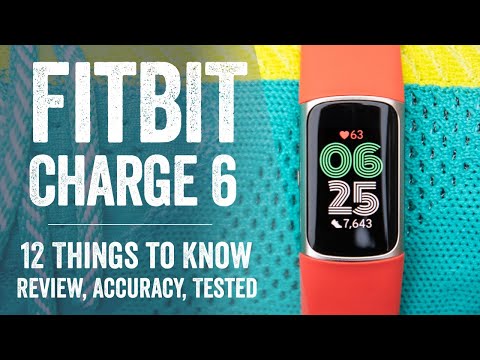
An in-depth walk-through of what changed from the Charge 5. It is the video closest in depth to the specialist testing above.
Watch on YouTube ↗John Lewis and Currys buyers
That is 595 ratings in total across two big UK retailers, and both average 4.5. These are reviews on pages that sell the product, and most were written within weeks of buying, so they tell you about everyday satisfaction more than long-term reliability. The praise is for the health and sleep tracking and the Google extras: Google Maps, Google Wallet payments and YouTube Music controls on the wrist. The complaints in the John Lewis reviews are software glitches, occasional problems syncing with the phone, and battery life that drops when GPS is used a lot. That last one matches Trusted Reviews’ measured drain of about 15% per hour with GPS on.
On price and terms, both retailers list a two-year guarantee and water resistance to 50 m. Currys gives the wrist sizes for the two straps in the box, 130–170 mm and 170–210 mm, which is worth checking before you buy for a very small or very large wrist. John Lewis was £139.99 and Currys £139.00 on 5 October 2026, the same as Google’s own £139.99. On that day nobody was discounting it.
Watch: FitBit Charge 6 - 60-Day Review

An owner’s view after two months of daily wear, which is closer to what retail buyers write about than a launch-week review.
Watch on YouTube ↗Charge 6 or spend more on a Forerunner 165?
This is the question most people should ask before buying. On 5 October 2026 the Garmin Forerunner 165 was £199.99 at Currys, so it cost £60.99 more than the Charge 6 there. On 18 September Currys had it at £169, so it is worth waiting for a sale. Here is what the extra money buys, based on the testing above and on our Forerunner 165 page:
- GPS you can rely on without a phone. The Forerunner is a running watch first. The Charge 6’s own GPS failed or wandered in four out of four tests.
- No subscription. Garmin’s coaching and training plans come free. Google’s AI coach and adaptive plans cost from £7.99 a month after the trial.
- A bigger screen and running features such as Garmin Coach plans and adaptive daily workouts.
The Charge 6 is the better buy for some people. It is slimmer and lighter to sleep in, it does contactless payments through Google Wallet, and its tracking of steps, sleep and heart rate is all most people need. If you run two or three times a week with your phone in your pocket, the Charge 6 uses the phone’s GPS and the weak spot does not matter. If you want to run without the phone, or you are training for a race, spend the extra on the Garmin.
Strengths and weak points
What holds up
- Seven-day battery that testers broadly confirmed with normal settings.
- Heart rate within 2 bpm of a chest strap on average in Expert Reviews’ steady runs.
- Both strap sizes in the box, covering wrists from 130 to 210 mm.
- Water resistant to 50 m and swimproof.
- Google Wallet, Google Maps and YouTube Music controls on the wrist.
- Activity, sleep score, heart rate, HRV, SpO2 and Readiness are all free under Google Health.
- 4.5/5 from 595 UK buyers across two retailers.
What people complain about
- Built-in GPS is weak, in every test we found. Plan to use your phone’s GPS.
- Heart rate lags or over-reads in hard intervals, especially when worn loose.
- Needs a Google Account. There is no way around it.
- The AI coach, adaptive plans, detailed sleep insights and workout library cost from £7.99 a month after the trial.
- The side “button” is a haptic pad that does not move, and the tuck-in strap is fiddly.
- Heart-rate broadcast is non-standard and failed on Zwift.
- Buyers report software glitches and occasional sync problems.
Who it actually suits
Buy it if you want a comfortable band for steps, sleep, heart rate and contactless payments, and you already have a Google Account. It is also a good buy if your runs, walks or rides are with your phone in a pocket. At £139 with a two-year guarantee it is a safe gift. You do not need the subscription. Try the free months, then decide whether the AI coach is worth £7.99 a month to you.
Look elsewhere if you want to run without your phone and trust the pace and distance, train with intervals, ride on Zwift, or would rather not use a Google Account. For running, the Garmin Forerunner 165 is the step up. If you only want sleep and activity data and do not need a screen, the £84.99 Fitbit Air is worth a look, but we have not reviewed it.
What we could not check
- The videos. We could not open YouTube from our research setup. Instead we confirmed each video by finding its exact address and title in two differently worded web searches. The search listings did not name the channel for any of the three, so we have not named one.
- The Premium price in pounds per year. Google’s UK store says “from £7.99” a month. TechRadar reports £7.50 a month or about £75 a year. In the US it went up to $99.99 a year in May 2026. We could not find a UK annual price on a Google page.
- Which trial you get. The Google Store offers three months of Google Health Premium. John Lewis still lists six months of Fitbit Premium, and the titles of two Amazon listings disagree (three months on one, six on the other). Check the listing in front of you.
- Expert Reviews’ “£18 a month” figure. The review does not say how it is made up, and it was written before the price rise and rebrand.
- Whether the GPS has improved since launch. All four GPS tests date from 2023–24. We found no retest after later software updates.
- Long-term reliability. Retail reviews are mostly written soon after purchase. We found no data on strap or battery wear after two years.
- Argos and Amazon ratings. Argos’s page did not load for us, and Amazon blocks automated reading. We have not used either.
- The Fitbit Edge. It is a leak, not a product. If Google launches it, this page will need revisiting.
Sources and prices last checked 5 October 2026. Fitness-tracker prices move sharply around sales, and Google’s subscription terms have changed once this year already. Check the listing in front of you before ordering.