
Makita DHP485 Review: The Brushless Combi B&Q Sells, and the 50Nm Catch
Every source we found rates the DHP485 as a well-made, genuinely compact brushless drill that will do almost anything a house needs. What none of them says loudly enough is that its headline 50 Nm is lower than the cheaper, older DHP482 it sits above — because it is a different measurement of a different machine — and that four different products at B&Q wear the same DHP485 name at wildly different prices.
Where the reviews line up
No consumer title has bench-tested the DHP485, so the evidence comes from three places that each know something the others do not: Homebuilding & Renovating, whose tester Garry Martin put the closely-related DHP482 through a review and is the only hands-on judgement anywhere near this tool; ITS Hub, the buying guide written by a Makita trade supplier that sets the whole combi range side by side; and Power Tool World, a tool retailer carrying 59 customer ratings on the bare unit.
They agree on the tool itself. It is brushless, compact and light — Makita quotes 182 mm nose to tail, which is the number that actually matters between joists and inside kitchen carcasses. It is two-speed, 0–500 and 0–1,900 rpm, with 21 clutch settings plus a drill mode and a hammer mode. It carries XPT dust and water sealing, the feature the Homebuilding review singles out for anyone working outdoors. And the ratings that exist are strong: 4.8 out of 5 from 59 reviews at Power Tool World on 18 September 2026.
Where it gets awkward is torque. Makita publishes 50 Nm for the DHP485. ITS Hub publishes 60 Nm for the older DHP482, and Homebuilding quotes 62 Nm for the DHP482M1JW it tested. So the cheaper, brushed drill one rung down appears to out-muscle the brushless one — and ITS Hub, a firm that sells both, openly recommends the DHP482 as the better value. That comparison is not as damning as it looks, but you should understand it before you spend, and we set it out below.
The buying decision is mostly about which box you pick up. At B&Q the name DHP485 covers a bare body, a two-battery kit, a 5.0Ah kit with a bit set and a Makpac kit. Power Tool World wanted £129 for the bare body alone on 18 September 2026. If you already own Makita 18V batteries, buy the body. If you do not, the kit price is the real price, and the batteries are most of it.
The three reviews this summary is built from
- Homebuilding & RenovatingGarry Martin's review, 17 August 2020 — of the DHP482M1JW, not the DHP485. The nearest thing to a hands-on test that exists.
- ITS HubRichard Hughes' Makita combi buying guide, published 28 September 2022, updated 15 January 2026. Written by a firm that sells the whole range.
- Power Tool World4.8/5 from 59 customer ratings on the DHP485Z bare unit — on a page that sells it.
Before the review: which DHP485 are you buying?
B&Q currently lists the DHP485 under at least four product codes, and they are not the same purchase. DHP485Z is the bare body — no battery, no charger. DHP485SFE is the kit B&Q's own listing describes as two 3.0Ah batteries and a Makita charger in a moulded plastic case. DHP485RTJ adds a 5.0Ah battery and a 101-piece screwdriver bit set. DHP485STX is another 5.0Ah kit. A price you see quoted for "the DHP485" is meaningless until you know which of those four it attaches to — and the cheapest prices you will find online are almost always the bare body.
Specification at a glance
| Spec | Figure | Whose figure, and the catch |
|---|---|---|
| Type | 18V cordless combi drill — drill, screwdriver and hammer modes | Combi, not SDS. It will put a 13 mm hole in brick; it is not a substitute for an SDS in concrete. |
| Platform | Makita 18V LXT | Takes BL1815N, BL1820B, BL1830B, BL1840B, BL1850B, BL1860B. The platform outlives the drill. |
| Motor | Brushless | Makita's own listing. The DHP482 one rung below is brushed — Homebuilding lists that as its main weakness. |
| Max torque | 50 N·m hard joint · 27 N·m soft joint | Makita's own figure is the 50 Nm hard-joint number, quoted by Makita, LECTURA and Power Tool World. The 27 Nm soft-joint figure comes from Power Tool World. ITS Hub gives the DHP482 60 Nm and Homebuilding gives it 62 Nm, so the older drill looks stronger on paper — see below. |
| Clutch | 21 settings, 1.0–5.0 N·m, plus drill and hammer modes | Makita. The clutch range is what you actually use for screws; the 50 Nm is the drill-mode ceiling. |
| Chuck | 13 mm keyless, 1.5–13 mm capacity | Makita. ITS Hub notes the chuck and gearbox housing are plastic on this model, not metal. |
| Speeds | 0–500 rpm low · 0–1,900 rpm high | Makita, corroborated by B&Q's own listing and Power Tool World. |
| Hammer rate | 0–7,500 bpm low · 0–28,500 bpm high | Makita. Blows per minute, not impact energy — no source publishes joules for this drill. |
| Max output | 350 W | Makita's product listing. |
| Capacities | Steel 13 mm · wood 38 mm · masonry 13 mm | Makita. Corroborated by Power Tool World. |
| Weight | 1.5–1.8 kg | Makita publishes a range, not a number, and the range is the battery. 1.5 kg is with the smallest BL1815N; 1.8 kg is at the BL1860B end. Makita does not publish a per-battery breakdown. LECTURA prints a flat 1.8 kg, which is the top of the range quoted as if it were the figure. B&Q's kit ships 3.0Ah cells, so the drill in your hand is somewhere in the middle and nobody has published where. |
| Length | 182 mm · height 237–255 mm depending on battery | Makita. The 182 mm is the number that decides whether it fits the gap. |
| In the box at B&Q | DHP485SFE: two 3.0Ah batteries, charger, moulded plastic case | B&Q's own product page, checked 18 September 2026. The DHP485Z body sold alongside it contains the drill and a belt clip — nothing else. Power Tool World lists exactly that for £129. |
| Warranty | 3 years stated by Power Tool World | We could not confirm the registration terms against Makita UK — treat the three years as the retailer's claim. |
| Price | £129.00 inc VAT for the bare DHP485Z at Power Tool World, 18 September 2026 (out of stock) | B&Q does not render a price to us — its listing is JavaScript-built. A price comparison listing showed the DHP485 "from £67.99" on the same date, which will be a bare body from a marketplace seller, not a kit. |
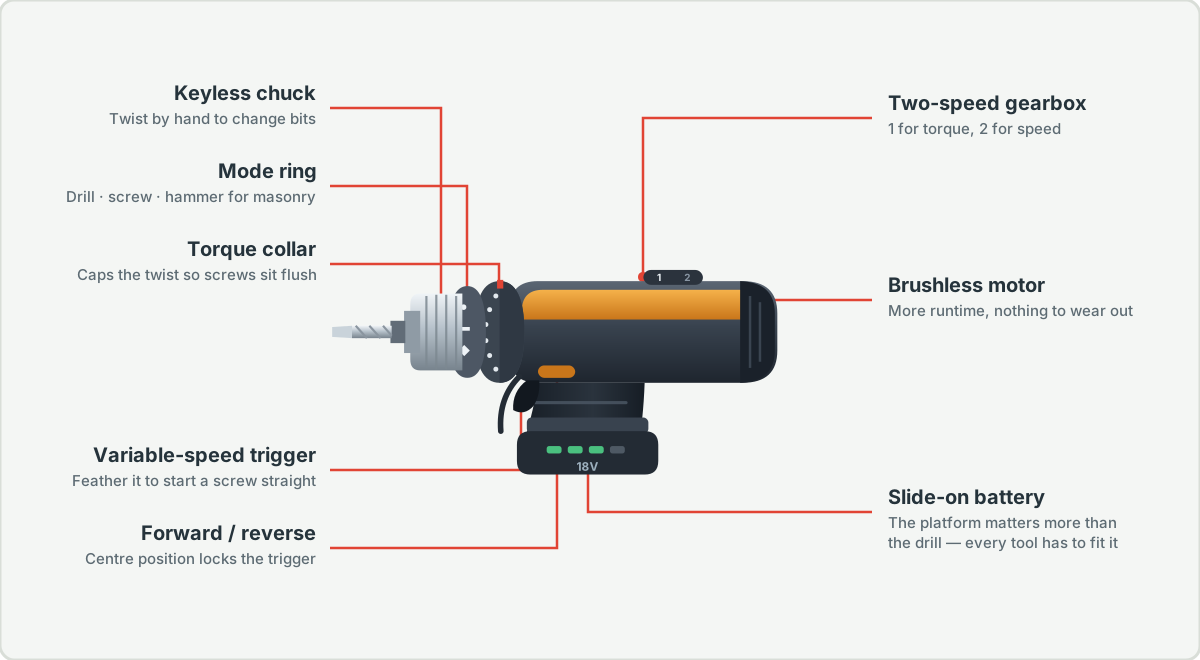
What the parts do
Homebuilding & Renovating
We have to be straight about what this is: Martin reviewed the DHP482M1JW, not the DHP485. It is the model directly below, it is brushed rather than brushless, and the review is from 2020. We are using it because after a full search we could find no independent editorial test of the DHP485 itself, and because the two drills share the chassis, the chuck, the two-speed gearbox and the XPT sealing. Where Martin describes the handling, the case and the charger, that carries across. Where he quotes torque, it does not.
His figures are the useful part. He quotes the DHP482 at 62 Nm in first gear and 36 Nm in second, and 1.8 kg with the 4.0Ah battery fitted — note that he states the battery, which is exactly what most listings fail to do. He is enthusiastic about the charger, which brings a 4.0Ah cell back in 36 minutes, and about XPT for wet and dusty sites. His single criticism is the one the DHP485 answers: the brushed motor is less efficient. That is the honest case for spending more on the 485 — not more torque on paper, but a motor that runs cooler, draws less from the same battery and has no brushes to wear out.
What he cannot tell you, because he was not holding this drill: how the DHP485 behaves in masonry, how long a 3.0Ah battery lasts in real work, or whether the plastic chuck housing ITS Hub flags is a durability problem.
Watch: Best Makita DHP485Z DDF485Z Brushless Cordless Compact Impact Drill Review
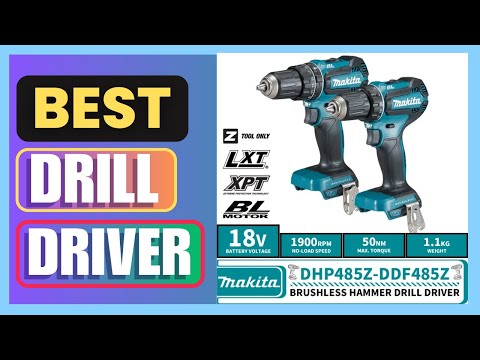
A comparison of the DHP485 combi against the DDF485 drill driver — the sister tool without hammer mode, which is the other decision people face at this price. We were not able to open this video; see the caveat box.
Watch on YouTube ↗ITS Hub
This is a buying guide written by a company that sells every drill it discusses, so it is not disinterested. It earns its place for one reason: it is the only source we found that puts the DHP485 in the context of the models either side of it, which is the question an actual buyer has. Hughes describes the DHP485 as a brushless, two-speed drill with a plastic gearbox housing and plastic chuck, 21 torque settings, delivering 50 Nm — matching Makita's own figure exactly.
Then he does something a marketing page would not. He gives the DHP482 60 Nm, calls it "our most popular", says it "has always offered an excellent combination of power and performance Vs value", and recommends the DHP482 over the DHP485 as the best-value pick for most site work. A retailer steering you to the cheaper drill is worth listening to.
But read the torque numbers carefully, because this is the trap on the whole page. Makita's 50 Nm for the DHP485 is a hard-joint rating — the figure you get driving into something unyielding. Power Tool World lists the matching soft-joint figure at 27 Nm. Neither ITS Hub nor Homebuilding states which method produced their DHP482 numbers, and Homebuilding's 62 Nm and ITS Hub's 60 Nm do not agree with each other either. Two numbers measured different ways are not a comparison, and we are not going to pretend they are: what we can tell you is that the brushless DHP485 carries the lower published figure, that the difference is real enough that ITS Hub recommends against it on value, and that for household work — fixings, flat-pack, a 13 mm hole in brick — both drills are far past the point where torque is what stops you.
Watch: Makita DHP485 18V Brushless Combi Drill - Quick Overview
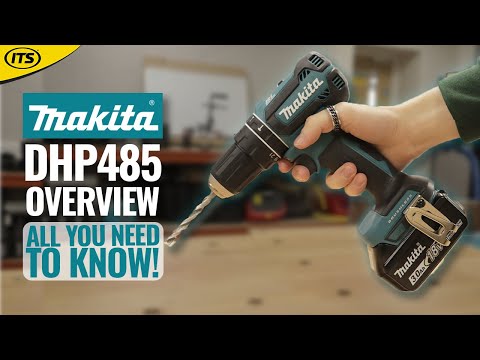
A short walk round the DHP485 itself — the controls, the modes and the size, which is the thing the specification sheet conveys worst. We were not able to open this video; see the caveat box.
Watch on YouTube ↗Power Tool World
Treat this for what it is: a ratings block hosted by the shop taking the money, with no stated verification that the raters bought it there. What makes it usable is the sample size. 59 ratings averaging 4.8 out of 5 is a real number attached to a real count, and we would rather print that than a five-star badge with nothing behind it. It is also specifically on the bare body, which tells you most of these buyers already owned Makita batteries — an existing-platform crowd, not first-time buyers.
The listing is the most useful spec source we found after Makita's own, and it is the one that publishes the soft-joint torque figure other retailers omit: 50 Nm hard, 27 Nm soft, 0–500 and 0–1,900 rpm, 0–7,500 and 0–28,500 bpm, 13 mm keyless chuck, capacities of 13 mm in steel and masonry and 38 mm in wood. It states a three-year warranty and it is blunt about the contents: one drill body and one belt clip, for £129.00 including VAT on 18 September 2026, when it was also out of stock.
That £129 is the number to hold in your head when you look at B&Q's kit. B&Q's DHP485SFE adds two 3.0Ah batteries, a charger and a case to the same drill. Whatever B&Q is charging on the day you look, the gap between the two is what you are paying for batteries — and if you already have LXT cells in the shed, that gap is money you do not need to spend.
Watch: Makita UK - What's In The Box? DHP485STX5

Makita's own unboxing of one of the DHP485 kits. Manufacturer-made and promotional, but it is the clearest answer to the question that decides the price — what you actually get for it. We were not able to open this video; see the caveat box.
Watch on YouTube ↗Strengths and weak points
What holds up
- Brushless motor — cooler running, more work per charge, no brushes to replace. The one thing Homebuilding held against the DHP482.
- 182 mm nose to tail. Compact enough for carcass work and between joists, which the torque figure will never tell you.
- Two genuinely useful speeds: 0–500 rpm for driving, 0–1,900 rpm for drilling.
- 21 clutch settings plus drill and hammer modes, so it covers screws, wood, steel and brick without a second tool.
- XPT dust and water sealing, praised by Homebuilding on the sibling model for outdoor work.
- 4.8/5 from 59 ratings at Power Tool World — a strong score with a stated sample size.
- 18V LXT platform: the batteries fit hundreds of other Makita tools and will outlast this drill.
What people complain about
- The published torque is lower than the cheaper DHP482's — 50 Nm against 60 Nm, and a trade supplier that sells both recommends the DHP482 on value.
- The soft-joint figure is 27 Nm, and most listings never print it.
- Plastic gearbox housing and plastic chuck, flagged by ITS Hub. Higher models in the range use metal.
- The quoted weight is a 1.5–1.8 kg range with no per-battery breakdown published anywhere.
- Four different products share the DHP485 name at B&Q, and the headline prices online are usually the bare body.
- It is a combi, not an SDS. 13 mm in masonry is the ceiling, and concrete will punish it.
- No independent consumer title has tested this exact model — the evidence base is thinner than the star ratings suggest.
Who it actually suits
Buy it if you are already on Makita's 18V LXT platform, or you are choosing a platform now and expect to add to it. Buy the bare DHP485Z if you have batteries and the kit if you do not, and treat the difference between those two prices as the battery cost it is. For a house — fixings into brick, flat-pack, decking, the occasional 38 mm hole in a joist — this drill is comfortably more capable than the work, and the brushless motor is the part you will still be glad of in five years.
Look elsewhere if your budget is tight and you want maximum drill for the money, in which case ITS Hub's advice to take the DHP482 is sound and comes from someone selling both. Look elsewhere too if you are drilling concrete rather than brick — that is an SDS job whatever the hammer rate says — or if you have no Makita batteries and no intention of buying more Makita tools, because on a one-tool purchase the platform premium buys you nothing.
What we could not check
- We could not open any of the three videos. YouTube refused every request from us on 18 September 2026 — repeated HTTP 429 responses, and a proxy-level block on direct fetches. The three videos on this page were confirmed a different way: each one's exact watch URL and exact title appeared in two or more differently-worded searches. That verifies the videos exist and are indexed; it does not prove they still play, and you should treat them accordingly.
- The channel behind two of the three videos. Only the Makita UK video names its channel, and it does so in the video title. No search snippet named the channel for the other two, and we are not going to guess at one.
- B&Q's live price and its own customer ratings. The diy.com listing is built in JavaScript and serves us the specification and box contents but no price, no stock status and no review count. Every price on this page is from somewhere else, and dated.
- Which battery gives which weight. Makita publishes 1.5–1.8 kg across six batteries and no breakdown. Since B&Q's kit ships 3.0Ah cells, the weight you will actually lift is unpublished.
- Whether the DHP482's torque figures are measured the same way as the DHP485's. Makita's 50 Nm is a hard-joint rating. Neither ITS Hub's 60 Nm nor Homebuilding's 62 Nm states a method, and they disagree with each other by 2 Nm. We have printed all three rather than pick one.
- Any independent test of the DHP485 itself. We searched and found none — no Which? test, no consumer title, no trade bench test on this model. The nearest is a 2020 review of the model below it. Nothing on this page is expert-test backing for the DHP485, because none exists.
- The three-year warranty terms. Power Tool World states three years; we could not confirm the registration requirements with Makita UK.
- Runtime, noise and vibration in use. No source publishes a runtime figure, a decibel reading or a vibration total for this drill.
- Stock. Power Tool World and B&Q's trade arm both showed the drill out of stock when we looked. B&Q's own stock position we could not read.
Sources last checked 18 September 2026. Tool prices and kit contents change constantly — check the code on the box, not just the model name, against the listing in front of you before ordering.