
Parcel theft cost £666.5m, but who pays when your delivery is stolen?
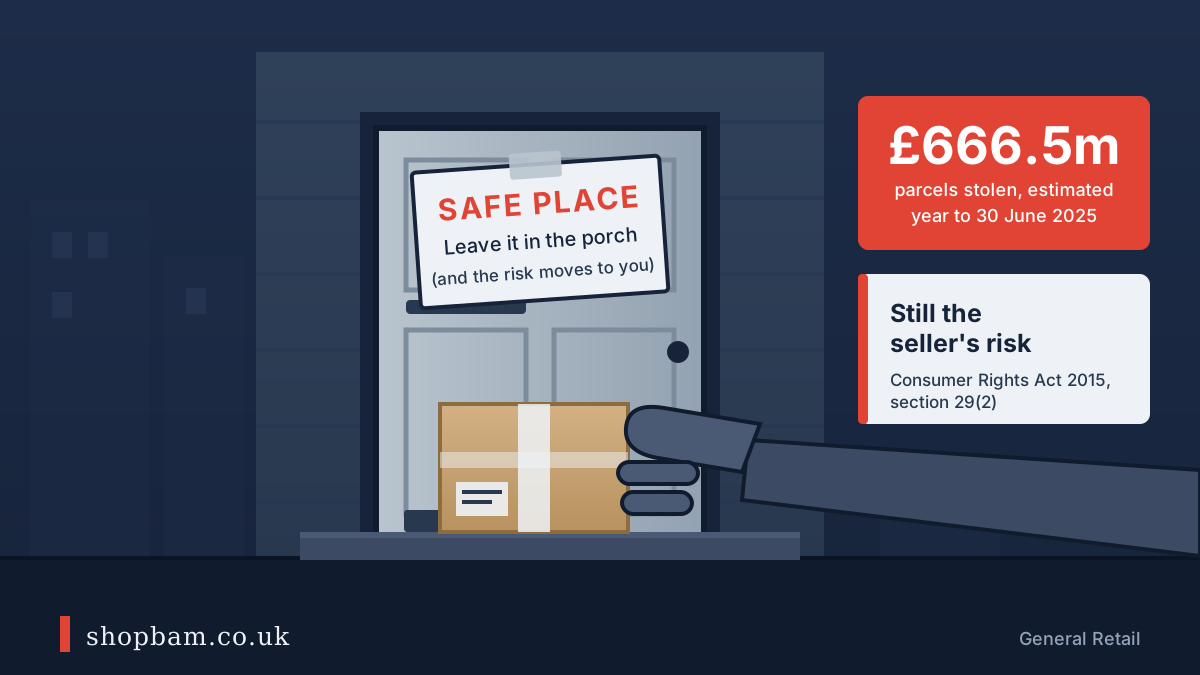
A widely reported figure says £666.5m of parcels were stolen from British doorsteps in a year. It is a real number built from real police data, but it is an estimate, it covers a period that ended in June 2025, and the firm that published it sells parcel lockers. The part nobody puts in the headline is the useful part: under the Consumer Rights Act 2015 the loss is normally the seller’s, not yours. The exception is when you told them to leave it somewhere.
Parcel theft: the figures, and where each one comes from
| Figure | Value | What it means |
|---|---|---|
| Value of parcels stolen, year to 30 June 2025 | £666.5m | Quadient / Parcel Pending "2025 Parcel Theft Report", covering 1 July 2024 to 30 June 2025. It is an estimate scaled up from police data, not a count. |
| The same figure a year earlier | £376.6m | The year-on-year jump is what made the headlines. Part of it is more thefts, part of it is each theft being worth more. |
| Average value of a stolen parcel | £138 | Up from £102 the previous year. |
| Homes affected | 4,828,000 | Up 31 per cent on the previous year. |
| How the headline is calculated | 4,828,000 × £138 | The £666.5m is literally the estimated number of affected homes multiplied by the average parcel value. Both inputs are themselves estimates. |
| Thefts reported to the police | 1 in 353 | Previously 1 in 333.3. Almost nobody reports it, which is precisely why the total has to be scaled rather than counted. |
| The police data behind it | 27 of 45 forces | Freedom of information requests went to all 45 territorial forces. The 27 that replied cover 32,374,700 people; the result was scaled to a UK population of 67,330,000. Only 13 forces supplied values. |
| Shoppers who prefer a locker or collection point | 64% | Censuswide survey for the same report, September 2025, 2,000 UK adults. 68 per cent said they would rather miss a delivery than risk it being stolen; 79 per cent want the authorities to take parcel theft more seriously. |
| Shoppers who have had a delivery problem | 67% | Collect+ / PayPoint research reported by Retail Gazette on 1 September 2026. In the same release, 73 per cent had used a parcel shop (79 per cent of 25 to 34-year-olds) and 1 in 12 named security as their main concern. |
| Shoppers who say delivery or collection choice matters | 87% | Same September 2026 Collect+ release; 88 per cent want a collection point near home or work. An earlier and separate PayPoint release in July 2026 put the same two questions at 86.5 per cent and 88.3 per cent. Different samples, so do not read them as a trend. |
| Delivery issues reported within six months | About 68% | House of Commons Library briefing CBP-10614, 31 March 2026, citing 2025 data. It also records that 26 per cent of complaints concerned parcels left in inappropriate locations. |
| People with a delivery problem in a single month | About 15m | Citizens Advice, 21 November 2024: 36 per cent of online shoppers, of whom 48 per cent then struggled to get it resolved. Opinium, 8,011 adults, fieldwork 13 September to 11 October 2024. |
| Who carries the risk in law | The trader | Consumer Rights Act 2015, section 29(2): goods stay at the trader’s risk until they come into your physical possession, or that of a person you identified to take them. |
What happened
The number doing the rounds is £666.5m. It comes from the "2025 Parcel Theft Report" published by Quadient and its Parcel Pending business, and it is worth understanding how it was built, because the construction tells you what it can and cannot support.
Quadient sent freedom of information requests to all 45 territorial police forces in the UK. Twenty-seven answered, between them covering 32,374,700 people, and thirteen of those were able to attach values to the thefts they recorded. Quadient scaled the response up to a UK population of 67,330,000, arriving at 4,828,000 homes affected in the twelve months to 30 June 2025, a rise of 31 per cent. It put the average stolen parcel at £138, up from £102. Multiply the two together and you get £666.5m. The previous year’s equivalent was £376.6m.
That is a legitimate method for a problem nobody reports. Only one theft in 353 reaches the police, by Quadient’s own count, so a straight tally would be almost meaningless. But it is scaling on top of scaling: an estimate of homes, multiplied by an average value drawn from thirteen forces. Treat it as an order of magnitude, not a measurement.
Check the period before you quote the number
The £666.5m covers 1 July 2024 to 30 June 2025. By the time it was being re-reported on 1 September 2026 it had quietly become "last year". It was not. It described a period that had ended fourteen months earlier. This happens to almost every piece of recycled retail research, and the fix is the same every time: find the fieldwork or measurement period before you let a figure change your behaviour.
Everyone publishing this research sells the answer to it
This is the part the trade coverage leaves out, so we will say it plainly. Quadient, which produced the £666.5m figure, sells parcel lockers, and its survey arm duly found that 64 per cent of people prefer lockers or collection points. PayPoint, whose research says 87 per cent of shoppers care about delivery choice and 88 per cent want a collection point near home or work, owns Collect+ and its 14,000-plus sites. iParcelBox, whose May 2026 report is headlined on the argument that "lockers aren’t the answer", sells doorstep parcel boxes.
None of that makes the numbers false. Commercial research is often the only research that gets done on a question like this. It does mean the framing is never neutral, and that the recommended remedy always happens to be the thing the publisher sells. Read the figures; ignore the conclusion the press release draws from them.
Keep the two PayPoint studies apart
There are two separate pieces of PayPoint research in circulation and they are easy to blur together. The September 2026 Collect+ release, reported by Retail Gazette on 1 September, gives 67 per cent having had a delivery problem, 73 per cent having used a parcel shop (79 per cent among 25 to 34-year-olds), 87 per cent saying delivery or collection choice matters, 88 per cent wanting a collection point near home or work, and one in twelve naming security as their main concern. The quote attached to it comes from Sam Holden, Director of Parcels and Ecommerce at PayPoint.
An earlier PayPoint release in July 2026, covering 2,000-plus consumers, gives 86.5 per cent on choice and 88.3 per cent on a collection point near home or work, plus 64.8 per cent willing to travel ten minutes at most, 63 per cent expecting delivery within two days and 61 per cent willing to pay more for it. Those are different samples asked at different times. Lining up 86.5 against 87 and calling it a rise would be nonsense, and we are not going to do it.
The law: it is the seller’s parcel until it reaches you
Section 29(2) of the Consumer Rights Act 2015 says, in terms: "The goods remain at the trader’s risk until they come into the physical possession of — (a) the consumer, or (b) a person identified by the consumer to take possession of the goods."
That is the whole ball game. A parcel stolen off your step never came into your physical possession, so in the ordinary case the loss is the trader’s and it is the trader who has to chase the courier. Citizens Advice puts it the same way: the seller deals with the delivery company, not you. Your contract is with the shop you bought from, and it is the shop you go back to.
Subsections 29(3) and (4) carve out the exception: risk passes at handover to the carrier if you commissioned a carrier that the trader did not name. If you booked your own courier to collect from a shop, that is on you. If you picked from the delivery options at checkout, you did not commission anything. The trader did.
The safe-place trap
Here is where people lose the argument. Citizens Advice is blunt about it: if you asked for the parcel to be left in a safe place or with a neighbour, you are unlikely to be able to claim when it goes missing. If you did not ask, the seller is still responsible, including when a courier left it in a bin store or behind a wheelie bin on its own initiative.
The Commons Library briefing suggests that second situation is common: 26 per cent of delivery complaints in its figures concerned parcels left in inappropriate locations. So the question that decides your claim is narrow and specific: did you give the instruction, or did the courier take the decision? Standing delivery preferences you set up once in a courier app, and then forgot, are exactly the sort of thing that turns a seller’s problem into your problem.
We could not find a court ruling on whether a "safe place" instruction legally counts as identifying a person under section 29(2)(b) (a porch is not a person), and retailers’ terms differ on the point. Do not rely on winning that argument.
When you can actually claim, and who regulates any of this
Citizens Advice sets out the timing: you can claim if the delivery fails within 30 days, or by an essential date you agreed, or by a second date you agreed after the first was missed. That is the practical trigger for going back to the seller.
If the seller stonewalls, the regulatory backstop is thinner than most people expect. The Commons Library briefing CBP-10614 records that Ofcom sets complaint-handling rules for postal operators but does not investigate individual complaints. In February 2026 the government said Ofcom "will consider whether enforcement action is necessary or additional regulation". That is a statement about a future review, not a route to your £138 back. The route to your money is the retailer, and then, if needed, your card provider or the small claims track.
How it unfolded
| Date | What happened |
|---|---|
| 13 September to 11 October 2024 | Opinium polls 8,011 adults for Citizens Advice. Around 15m people (36 per cent of online shoppers) report a delivery problem in the space of a month, and 48 per cent of those struggle to resolve it. |
| 1 July 2024 to 30 June 2025 | The twelve months the £666.5m figure covers. This is the detail lost in most of the coverage. |
| September 2025 | Censuswide surveys 2,000 UK adults for the survey arm of the Quadient / Parcel Pending report. |
| February 2026 | The government says Ofcom "will consider whether enforcement action is necessary or additional regulation", according to the House of Commons Library. |
| 31 March 2026 | House of Commons Library briefing CBP-10614 sets out what Ofcom does and does not do: it sets complaint-handling rules for postal operators but does not investigate individual complaints. |
| 13 May 2026 | iParcelBox publishes research arguing "lockers aren’t the answer": 60 per cent of thefts happen between 9am and 5pm, 30 per cent of victims switched to lockers, one household in six affected, reported cases up 77 per cent. iParcelBox sells doorstep boxes. |
| 27 July 2026 | A PayPoint release covering 2,000-plus consumers reports 86.5 per cent saying delivery choice matters, 64.8 per cent willing to travel ten minutes at most, 63 per cent expecting delivery within two days and 61 per cent willing to pay more. PayPoint owns Collect+, with 14,000-plus sites. |
| 1 September 2026 | Retail Gazette reports a further Collect+ / PayPoint study (67 per cent have had a delivery problem, 73 per cent have used a parcel shop), and the £666.5m figure is recycled alongside it as though it described the past year. |
What this means if you shop there
- Go back to the seller, not the courier. Under section 29(2) of the Consumer Rights Act 2015 the goods are at the trader’s risk until they are in your physical possession. Citizens Advice is clear that chasing the delivery company is the seller’s job. A shop that tells you to take it up with the courier is passing you a job that is legally theirs.
- Do not set a safe place unless you mean it. This is the single decision that moves the loss onto you. If you asked for the parcel to be left somewhere or with a neighbour, Citizens Advice says you are unlikely to be able to claim. If you did not ask and the courier decided for itself, the seller is still on the hook. Check the standing delivery preferences saved in your courier apps. An instruction you set once and forgot still counts as your instruction.
- The claim triggers on a date. You can claim if delivery fails within 30 days, or misses an essential date you agreed, or misses a second date agreed after the first was missed. Say which of the three applies when you write to the retailer.
- Ofcom is not going to get your parcel back. It sets complaint-handling rules for postal operators but does not investigate individual complaints. The February 2026 government line about considering enforcement or further regulation is about a future review, not your order.
- Treat £666.5m as an order of magnitude. It is 4,828,000 estimated homes multiplied by a £138 average value, drawn from 27 of 45 police forces and scaled to the whole UK population. It also covers the year to 30 June 2025, not the past twelve months, however it was reported in September 2026.
- Notice who is paying for the research. The locker figures come from a locker company, the collection-point figures from the company that owns Collect+, and the "lockers aren’t the answer" figures from a firm selling doorstep boxes. The numbers can still be useful; the recommendation attached to them is marketing.
- A collection point sidesteps the argument entirely. Sixty-eight per cent of people told Censuswide they would rather miss a delivery than risk theft, and collecting in person means the parcel is in your physical possession at a counter rather than on a step. That is a practical point rather than a legal one, but it removes the safe-place question before it can arise.
- We do not know how many of the 4.83m affected homes got their money back. No source we have publishes it. So we cannot tell you how often the law described above delivers a refund in practice.
Checked on 5 September 2026. A story this recent moves, so we update this box rather than leaving it to rot.
Where this came from
- Quadient / Parcel Pending: 2025 Parcel Theft Report £666.5m of parcels stolen in the year to 30 June 2025 against £376.6m the year before, a £138 average parcel, 4,828,000 homes affected, 1 theft in 353 reported, and the FOI method behind all of it · 2025
- Censuswide, for the same report Survey of 2,000 UK adults: 64 per cent prefer lockers or collection points, 68 per cent would rather miss a delivery than risk theft, 79 per cent want the authorities to take it more seriously · September 2025
- Retail Gazette, reporting Collect+ / PayPoint 67 per cent have had a delivery problem, 73 per cent have used a parcel shop, 87 per cent say delivery choice matters, 88 per cent want a collection point near home or work, 1 in 12 name security, with a quote from Sam Holden, Director of Parcels and Ecommerce at PayPoint · 1 September 2026
- Retail Times, reporting an earlier PayPoint release A separate study of 2,000-plus consumers: 86.5 per cent on delivery choice, 88.3 per cent on a nearby collection point, 64.8 per cent will travel ten minutes at most, 63 per cent expect delivery in two days, 61 per cent would pay more, 14,000-plus Collect+ sites · 27 July 2026
- Consumer Rights Act 2015, section 29 Goods remain at the trader’s risk until they come into the physical possession of the consumer or a person the consumer identified; risk passes at handover only where the consumer commissioned a carrier the trader did not name · Checked 5 September 2026
- Citizens Advice: problems with a delivery The seller chases the courier rather than you; a safe-place or neighbour instruction you gave makes a claim unlikely; the 30-day, essential-date and second-agreed-date triggers for claiming · Checked 5 September 2026
- House of Commons Library briefing CBP-10614 Ofcom sets complaint-handling rules but does not investigate individual complaints; the February 2026 government statement on possible enforcement or further regulation; about 68 per cent reporting a delivery issue within six months, and 26 per cent of complaints about parcels left in inappropriate locations · 31 March 2026
- Citizens Advice press release Around 15m people, or 36 per cent of online shoppers, had a delivery problem in one month, and 48 per cent then struggled to resolve it. Opinium, 8,011 adults, fieldwork 13 September to 11 October 2024 · 21 November 2024
- iParcelBox research The counter-argument that "lockers aren’t the answer": 60 per cent of thefts between 9am and 5pm, 30 per cent of victims switched to lockers, one household in six affected, reported cases up 77 per cent. iParcelBox sells doorstep parcel boxes · 13 May 2026
What we could not check
- Whether a "safe place" instruction legally counts as identifying a person under section 29(2)(b) of the Consumer Rights Act. We found no court ruling on the point and retailers’ terms differ. It matters, because it is the difference between the seller carrying the loss and you carrying it.
- The sample size and fieldwork dates for the September 2026 Collect+ figures. The July 2026 PayPoint release states 2,000-plus consumers; the September one, as reported, does not. That is why we have kept the two sets of percentages apart rather than comparing them.
- The worst month for parcel theft. Quadient’s release says December; the Parcel Pending write-up of the same report gives January 2025 at 2,379 cases against December 2024 at 1,138. The two are unreconciled, so we have left the monthly detail out entirely.
- What each courier’s current photo proof-of-delivery policy says, and whether a photo of your doorstep counts as evidence of delivery. Policies change and we did not verify any of them.
- How many of the 4,828,000 affected homes were refunded or replaced. No source we have publishes it, so we cannot say how often the law works in practice.
- Whether the 27 police forces that answered the FOI request are representative of the 18 that did not. The £666.5m depends on the assumption that they are.
Company figures are as reported by the businesses themselves or their administrators. Where two sources disagree, this page says so rather than picking one.