
Philips Azur 8000 DST8020 Review: No Dial, but Is It Worth £100-Plus?
There is no temperature dial on this iron. Philips says one setting works on every fabric you can iron without scorching it, and the people who have used it mostly agree. The real questions are its weight, its price, and the fact that the only hands-on test we could find was of its more powerful sibling.
Where the reviews line up
The evidence comes from three places: a two-month home test published by Mumsnet, 183 buyer ratings at John Lewis, and Philips’ own product page and spec leaflet for the DST8020/26. They agree on more than they disagree on.
Everyone agrees on the single-setting OptimalTEMP idea. You switch it on and iron without sorting the wash by fabric. Mumsnet’s tester found it got through creases well enough to compare it with a steam generator. Second, it heats up fast. At 3,000 W, Mumsnet timed it at just over a minute. Third, the 2.5 m cord is long and gives you more reach than the 2 m on most budget irons.
The same two complaints come up throughout. It is heavy. Philips lists it at 1.78 kg, and Mumsnet calls the weight its main drawback. It is expensive for a steam iron that is not a generator. And the John Lewis score of 3.9/5 is lower than the price would lead you to expect.
Most of the buying decision is about the model number. The DST8020 gives 55 g/min of continuous steam, a 240 g shot and a 300 ml tank. The DST8050, which Mumsnet appears to have tested, gives 85 g/min, a 260 g shot and 350 ml. The design is the same but the steam output is not, so check the code on the box before you pay.
The three reviews this summary is built from
- MumsnetTwo months of family and Airbnb-linen ironing. Hands-on, but the figures it quotes match the DST8050 sibling.
- John Lewis3.9/5 from 183 customer reviews on the DST8020/26 page, checked 5 Oct 2026.
- PhilipsManufacturer page and spec leaflet for the DST8020/26. The source for the official figures.
Before the review: two irons share one name
The name “Azur 8000” covers more than one model. The DST8020 (this page) is rated at 55 g/min continuous steam, a 240 g boost and a 300 ml tank. The DST8050 is rated at 85 g/min, a 260 g boost and 350 ml. Both are 3,000 W and use OptimalTEMP. Reviews and listings often mix them up. Our original assignment for this slot was the Morphy Richards Crystal Clear. We switched because only one YouTube video of it could be confirmed, and every page here needs three.
Specification at a glance
| Spec | Figure | Confidence |
|---|---|---|
| Model | DST8020/26 (light blue) | Philips UK product page |
| Power | 3,000 W | Philips; John Lewis agrees |
| Continuous steam | 55 g/min | Philips; John Lewis agrees |
| Steam boost | 240 g | Philips (“240 g shot”); John Lewis lists it as 240 g/min |
| Water tank | 300 ml | Philips; John Lewis agrees |
| Soleplate | SteamGlide Elite (Philips) · “stainless steel” (John Lewis) | Sources describe it differently, see below |
| Temperature control | OptimalTEMP: one setting, no dial | Philips says no burns on any ironable fabric |
| Limescale | Quick Calc Release and self-clean; tap water suitable | Philips; John Lewis also says tap water is fine |
| Auto shut-off | Yes, after 8 minutes | Time from the Philips leaflet; product page says “yes” |
| Cord length | 2.5 m | Philips; John Lewis agrees |
| Weight | 1.78 kg (Philips) · 1.66 kg (John Lewis) | The two published figures differ |
| Dimensions | 33.3 × 13.5 × 17.5 cm (L × W × H) | Philips leaflet |
| Guarantee | 2 years | Philips (“worldwide”); John Lewis agrees. No extension for registering found |
| Running cost | No energy label. At most 3 kWh per hour of use, and less in practice because the element cycles | Our arithmetic from the 3,000 W rating. Multiply by your tariff |
| UK price | £119.99 at John Lewis · £99.99 at Amazon via PriceSpy | Both checked 5 Oct 2026. Philips UK shows no price |
Mumsnet
This is a home test, not a lab test. One tester used the iron for two months in a five-bedroom house, on the family’s everyday ironing and on bedding for Airbnb guests. The review does not name a model code. The figures it gives (85 g/min continuous steam, a 260 g shot and a 350 ml tank) belong to the DST8050, not the DST8020. Read it as evidence about the shared design: the weight, the cord, the heat-up time and the OptimalTEMP approach. Do not read it as evidence of how much steam the DST8020 produces.
On those shared points, the verdict is positive. The iron glides very efficiently, heats up in just over a minute and handles creases well enough that the tester compared it with a steam generator. One tank lasted a whole set of bedding. The anti-calc filter and the long lead are listed as advantages. The drawbacks are the weight, which is the first complaint, and the price, quoted at £125 at the time of writing. The tester did not comment on spitting, leaks or how the iron lasts over time, and two months is too short to judge durability.
Watch: Philips Azur 8000 Steam Iron Review
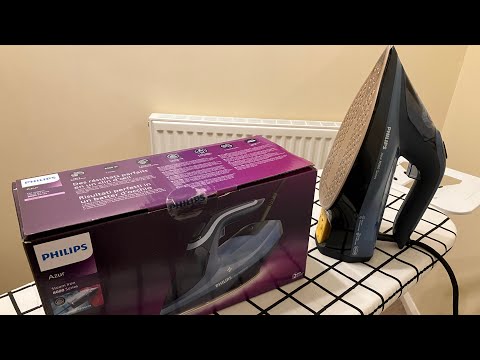
A general review of the Azur 8000. The title gives no model code, so like the Mumsnet test it may show either version.
Watch on YouTube ↗John Lewis
This is the biggest pool of owners for the exact model, and the most telling single number on this page. A score of 3.9 out of 5 from 183 reviews is respectable but not strong, and it is lower than you would expect for an iron that costs well over £100. The retailer hosts these reviews on a page that sells the product. We could not see the individual comments or the star breakdown, so we cannot say whether the lower ratings come from faults, the weight or buyers who expected more steam. Take the score as a signal that not every buyer was won over. It is not a diagnosis.
John Lewis’s listing matches Philips on almost every figure: 3,000 W, 55 g/min, 300 ml, a 2.5 m cable, tap water suitable, anti-calc and a two-year guarantee. It differs on two. It gives the weight as 1.66 kg against Philips’ 1.78 kg, and it calls the soleplate stainless steel where Philips names its own SteamGlide Elite coating. We show both figures above rather than choosing one.
Watch: Philips Azur 8000 Series DST8020/26 Steam Iron Testing

The only one of the three clips whose title names the exact DST8020/26. Watch this one if you want to see the model this page covers.
Watch on YouTube ↗Philips
Philips’ main claim is that OptimalTEMP removes the risk of scorching, so “no burns on any ironable fabrics” and no setting to choose. The rest of its spec sheet supports the practical case. The iron is tap water suitable, which matters in hard-water areas, and it has Quick Calc Release and self-clean for limescale. It also has drip stop, vertical steaming and an 8-minute auto shut-off, which is the figure in the leaflet.
These are the manufacturer’s own figures and none of them is independently tested. Two points are worth knowing. Philips’ “1.78 kg” matches what Mumsnet quoted for the sibling, so the heavier figure is probably the right one to plan around. And the guarantee is two years, with no extension for registering the iron that we could find. Morphy Richards, by comparison, offers a third year when you register.
Watch: Philips Azur 8000 Series DST8020

A short clip named after the DST8020. We could not see who made it, so it could be promotional.
Watch on YouTube ↗Strengths and weak points
What holds up
- OptimalTEMP means one setting for every ironable fabric, with no dial to forget.
- Fast heat-up at 3,000 W, timed at just over a minute in the Mumsnet test.
- A 2.5 m cord gives more reach than most budget irons.
- Tap water suitable, with Quick Calc Release and self-clean for hard-water areas.
- Auto shut-off after 8 minutes, plus drip stop and vertical steam.
What people complain about
- Weight: 1.78 kg by Philips’ figure, and the tester’s first complaint.
- Price: £100 to £120 for an iron that is not a steam generator.
- 3.9/5 from 183 John Lewis buyers is lower than the price suggests.
- The DST8020 has less steam and a smaller tank than the DST8050, and the two are easily confused.
- A two-year guarantee with no extension for registering.
Who it actually suits
Buy it if you iron a mixed load (shirts, cottons, synthetics and bedding) and want to stop changing the temperature or scorching the odd delicate item. It also suits you if you live in a hard-water area and want to fill it from the tap. Shop around: at the time of checking, Amazon was about £20 cheaper than John Lewis.
Look elsewhere if you have weak wrists or iron for long sessions, because the weight is the most common complaint. If you mainly want more steam, pay a little more for the DST8050 or look at a steam generator. If you iron a few shirts a week, a £20 to £25 iron such as Morphy Richards’ Crystal Clear (30 g/min, 1.2 kg, a 2-year guarantee plus 1 more year when you register) covers most of what you need.
What we could not check
- An independent test of the DST8020 itself. Which? lists a test of this model, but the score is for members only, so we have not used it. The Mumsnet test appears to be of the DST8050.
- The John Lewis review text and star breakdown. We saw the 3.9/5 from 183 score but could not read the comments, so we cannot tell you what the unhappy buyers complained about.
- Weight. Philips says 1.78 kg and John Lewis says 1.66 kg. Neither says whether its figure includes water.
- Soleplate material. Philips names its SteamGlide Elite coating, while John Lewis says stainless steel. We have not resolved which is right.
- Noise, spitting and long-term reliability. None of our three sources covers them.
- The three videos. We confirmed them by search listing, not by opening them. YouTube would not load through our tools. Each video’s title and address appeared in two differently worded searches, but the listings did not name the channel.
- Philips’ own UK price. The Philips page showed no price or RRP, so the price range comes from two retailers.
Sources last checked 5 October 2026. Prices change quickly, and so do model codes on irons, so check the code on the listing in front of you before ordering.