
Deposit return scheme: what the 20p will cost you
The trade press spent this week on the producer fee: 0p for the first fifteen months. The number that lands in your basket is a different one: a flat 20p refundable deposit on every can and single-use plastic drinks bottle from 1 October 2027. Glass is out in England, Scotland and Northern Ireland. Plastic milk bottles are out everywhere. And a crushed can will not scan.
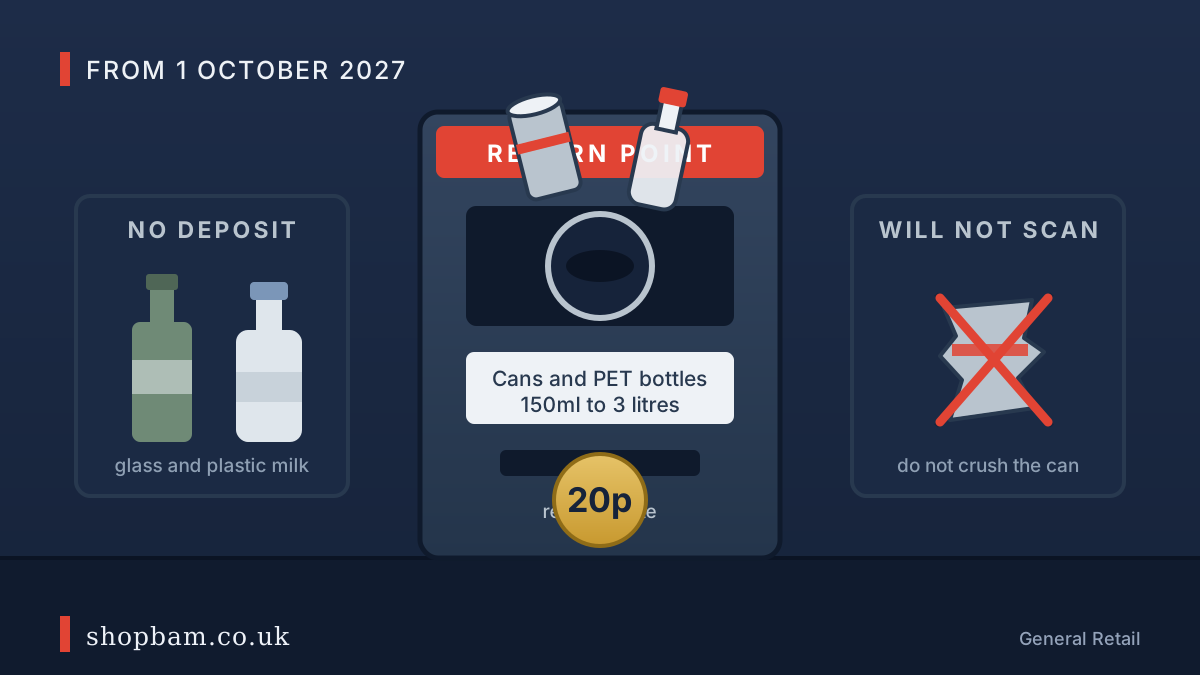
The deposit return scheme in numbers, as they stood in September 2026
| Figure | Value | What it means |
|---|---|---|
| The deposit | 20p | Flat, on every container in scope whatever its size or material. Confirmed by Exchange for Change, the not-for-profit scheme administrator, on 24 April 2026. It tested 10p to 30p: below 15p missed the return target, 30p was judged disproportionate for shoppers. |
| Start date | 1 October 2027 | GOV.UK guidance: "customers will pay a refundable deposit". The Commons Library briefing CBP-10453 says all four nations start on that day. |
| Return target | 90 per cent of containers | The target the deposit level was set to hit. Exchange for Change rejected variable rates because schemes abroad see fewer small containers come back. |
| What carries the deposit | PET plastic, steel and aluminium, 150ml to 3 litres | Single-use drinks containers only. That is your cans, your water and fizzy drinks bottles, your meal-deal bottle. |
| What does not | Glass, plastic milk bottles, cartons | Glass is out of the England, Scotland and Northern Ireland schemes on safety, storage and recycling-quality grounds (Commons Library). HDPE milk bottles are out per GOV.UK. So are cartons, anything under 150ml and anything over 3 litres. |
| Wales | Glass in, but at 0p for four years | Exchange for Change was appointed for Wales on 20 August 2026. Wales includes glass from day one, with a four-year transition at a 0p deposit and no labelling requirement. |
| A 24-pack of cans | £4.80 of deposit | Our arithmetic, not a published figure: 24 × 20p. You get it back when the cans go back. |
| Fifteen containers a week | £3 a week, about £156 a year held | Our arithmetic again. It is refundable, so it is money tied up rather than money spent, unless you stop bothering to return them. |
| Producer fee (the trade story) | 0p to Dec 2028, then 0.6p or 2.3p | 0p for the first fifteen months from October 2027. From January 2029 to December 2032, 0.6p per steel or aluminium container and 2.3p per PET one. Reviewed and reconfirmed in May 2027, then annually after launch. |
| Handling fee paid to shops | 3p manual, 5p by machine | Exchange for Change, 10 June 2026: 5p per container through a reverse vending machine for the first 225,000 a year, 1.3p above that; 3p for a manual return point. |
| Set-up grants for small shops | £60m fund, £6,000 a site | £2,000 a year over three years, starting three months after a machine is installed, for up to 10,000 small independents. |
| Which shops must take your empties | Most of them, by size | Urban shops under 100m² are automatically exempt; 100 to 199m² urban and under 200m² rural may apply; a grocery shop of 200m² or more starts from a presumption against exemption. |
| A missing lid | Not a reason to refuse you | Regulation 10(3) of the 2025 Regulations says a missing lid does not count as damage. Soiled, not empty or not intact do count. |
| How you get the 20p back | Cash, card or voucher | Regulation 47(1) to (2) allows "cash in sterling", "a payment to a debit or credit card" or "a refund voucher". Which one you get is the retailer's choice. |
What happened
On 2 September 2026 Exchange for Change, the not-for-profit set up to run the deposit return scheme in England, Scotland and Northern Ireland, published what drinks producers will pay it. The answer was nothing at all for the first fifteen months, then 0.6p a can and 2.3p a plastic bottle from January 2029 to December 2032. Its chief executive, Russell Davies, said the introductory rate was "intended to support businesses in the early stages of the scheme". The trade press ran it as a business story, which is what it is.
Underneath it sits the number that changes what you hand over at the till. From 1 October 2027 every drinks container in scope carries a flat 20p refundable deposit, and you pay it whether you return the container or not. Exchange for Change confirmed the level on 24 April 2026. It modelled 10p to 30p and landed in the middle: anything below 15p missed the 90 per cent return target the scheme is built around, and 30p was judged disproportionate for shoppers. Variable rates (less on a small can, more on a big bottle) were rejected because schemes abroad see fewer small containers come back when the deposit on them is trivial. Davies called a flat 20p "the most proportionate and sustainable amount for the UK".
One housekeeping note on dates. Exchange for Change dated its fee announcement 2 September 2026; Retail Gazette carried it on 3 September. We have used the operator's own date throughout and flagged the difference rather than quietly picking one.
What carries the 20p and what does not
In scope: single-use containers made of PET plastic, steel or aluminium, from 150ml to 3 litres. In practice that is cans of anything, water and fizzy drinks bottles, and the bottle in your meal deal.
Out of scope, and this is the part worth remembering at the shelf edge: glass is excluded in England, Scotland and Northern Ireland. The Commons Library gives the reasons as safety, storage and recycling quality. Plastic milk bottles, the HDPE ones, are excluded too, per GOV.UK. So are cartons, anything under 150ml and anything over 3 litres. A four pint of milk and a bottle of wine will cost the same on 1 October 2027 as they did the day before. A twelve-pack of cola will cost £2.40 more up front.
Wales has gone its own way. Exchange for Change was appointed there on 20 August 2026 and the Welsh scheme includes glass from day one, but with a four-year transition during which the glass deposit is 0p and there is no labelling requirement. If you live near the border, expect the two sides of it to behave differently for years.
There is also a small-producer carve-out. Products sold in volumes under 5,000 units a year across the whole UK are exempt from the deposit, the producer fee and the labelling rules, though the producer still has to register. Your local cider or a niche imported soft drink may simply not carry a deposit.
Getting the money back is the bit that will annoy people
Shops have to register with Exchange for Change and host a return point unless they are exempt. The exemptions run on floor area: an urban shop under 100m² is automatically out, an urban shop of 100 to 199m² or a rural shop under 200m² can apply, and a grocery shop of 200m² or more starts from a presumption against being let off. A shop can also be exempted for a health-and-safety breach or because it sits very close to another return point. The upshot is that the supermarket you do a big shop in will take your empties; the small newsagent on the corner may not.
The single most practical line we found comes from the Association of Convenience Stores: a manual return point cannot accept a crushed container, because the barcode has to scan. Two decades of being told to crush cans to save space in the recycling bin is about to become two decades of habit that costs you 20p a time. Do not crush them.
The law is more generous than you might expect on damage. Under the Deposit Scheme for Drinks Containers (England and Northern Ireland) Regulations 2025, regulation 10(1) lets a collector refuse a container where it has "a reasonable excuse not to accept" it, and regulation 10(2) lists grounds including that the container is "soiled", "not empty" or "not intact". But regulation 10(3) says a missing lid is not damage. A ring-pull can with no lid and a bottle whose cap went in the bin are both still refundable.
On the refund itself, regulation 47(1) to (2) allows the money to come back as "cash in sterling", "a payment to a debit or credit card" or "a refund voucher". All three are lawful, so the choice belongs to the shop, and a voucher redeemable only in that shop is a legitimate answer. No large grocer has published which it will use.
Online shopping is the hole in the scheme
If you buy your drinks in a supermarket delivery, you will pay the deposit like everyone else. Getting it back is your problem. The joint policy statement confirms there is no mandatory takeback obligation on online retailers at launch. Businesses may choose to register as a takeback service provider, and an industry working group has been asked to look at voluntary solutions, but nothing obliges the van that brought your crate of cans to take the empties away. That is the weakest point in the design, and it falls hardest on people who shop online because getting to a shop is difficult.
Where an unreturned 20p ends up
Unredeemed deposits are one of the three revenue streams that fund the scheme administrator, alongside producer fees and the sale of collected material. Every container you pay 20p on and do not take back is a small contribution to running the system. That is deliberate design rather than a loophole, but it is worth knowing: the scheme is partly funded by people who cannot be bothered, or who cannot easily get to a return point.
How it unfolded
| Date | What happened |
|---|---|
| 24 April 2026 | Exchange for Change, the not-for-profit deposit management organisation, confirms a flat 20p deposit for England, Scotland and Northern Ireland after testing 10p to 30p. |
| 10 June 2026 | Handling fees for retailers published: 3p manual, 5p by machine to 225,000 containers a year and 1.3p above, plus a £60m grant fund for small shops. |
| 20 August 2026 | Exchange for Change is appointed for Wales, which includes glass but starts it at a 0p deposit for four years. |
| 2 September 2026 | Exchange for Change publishes producer fees: 0p for the first fifteen months, then 0.6p and 2.3p from January 2029. Retail Gazette carried the story on 3 September. |
| May 2027 | The fee levels are due to be reviewed, validated and reconfirmed before launch. |
| 1 October 2027 | The scheme starts. You pay 20p on top of the price of every can and single-use plastic drinks bottle in scope, and get it back when you return the container. |
| January 2029 | The 0p introductory producer fee ends. Fees of 0.6p per metal container and 2.3p per PET container run to December 2032. |
What this means if you shop there
- Budget for the up-front hit, not a price rise. A 24-pack of cans carries £4.80 of deposit (our arithmetic, not a published figure). A household putting fifteen containers a week through the door is holding about £3 a week, roughly £156 a year, in deposits. It is refundable. It is still money that leaves your account first.
- Stop crushing cans. The Association of Convenience Stores is explicit that a manual return point cannot take a crushed container, because the barcode has to scan. This is the single easiest way to lose 20p a can.
- A missing lid is fine. Regulation 10(3) says so plainly. If a shop refuses a lidless bottle, it is wrong. Soiled, not empty and not intact are the grounds it can use.
- Glass and milk are not affected in England, Scotland and NI. Wine, beer in glass and plastic milk bottles carry no deposit. In Wales glass is in the scheme but at 0p for the first four years.
- Expect a voucher as often as cash. The regulations allow cash, a card payment or a refund voucher, and the choice is the retailer's. We could not find a single large grocer that has said which it will do, so we cannot tell you whether your 20p comes back as coins or as credit in that shop.
- If you shop online, assume nobody will collect your empties. There is no mandatory takeback obligation on online retailers at launch. Some may volunteer; none has committed as far as we can find. If you cannot easily get to a shop, this is the part of the scheme to complain about now rather than in October 2027.
- Do not assume your nearest shop will be a return point. Small urban shops under 100m² are automatically exempt and others can apply. No map of return points has been published, so where yours will be is not yet knowable.
- The 20p is not optional and not a tax you can dodge. Unreturned deposits part-fund the scheme. If you never take containers back, you are simply paying 20p a container.
Checked on 5 September 2026. A story this recent moves, so we update this box rather than leaving it to rot.
Where this came from
- Exchange for Change The scheme administrator for England, Scotland and Northern Ireland: the flat 20p deposit, the 10p to 30p range it tested, the 90 per cent return target and the Russell Davies quote · 24 April 2026
- Exchange for Change Producer fees: 0p from October 2027 to December 2028, then 0.6p per steel or aluminium container and 2.3p per PET container to December 2032, with a review in May 2027 · 2 September 2026 (Retail Gazette carried it 3 September)
- Exchange for Change Retailer handling fees (3p manual, 5p by machine to 225,000 containers a year and 1.3p above) and the £60m grant fund paying £6,000 a site over three years to up to 10,000 small independents · 10 June 2026
- GOV.UK deposit return scheme guidance The 1 October 2027 start, that "customers will pay a refundable deposit", and the exclusion of HDPE plastic milk bottles · Checked September 2026
- House of Commons Library briefing CBP-10453 All four nations starting on 1 October 2027, and the safety, storage and recycling-quality reasons glass is excluded in England, Scotland and Northern Ireland · Checked September 2026
- Deposit Scheme for Drinks Containers (England and Northern Ireland) Regulations 2025 Regulation 10(1) to (3) on refusing a container and a missing lid not counting as damage, regulation 47(1) to (2) on cash, card or voucher refunds, and regulation 26(8) on displaying the deposit level with the price · Checked September 2026
- Association of Convenience Stores, DRS resources centre That a manual return point cannot accept a crushed container because the barcode has to scan · Checked September 2026
- Joint policy statement on the deposit return scheme No mandatory takeback obligation on online retailers at launch, the voluntary takeback service provider route and industry working group, the retailer exemption thresholds by floor area, and the under-5,000-unit low-volume exemption · Checked September 2026
- letsrecycle Exchange for Change appointed for Wales on 20 August 2026, with glass included but on a four-year transition at a 0p deposit and no labelling requirement · 20 August 2026
What we could not check
- Whether a return point has to accept a container you bought somewhere else. Regulation 10(2) does not list it as a ground for refusal, but we found no plain statement either way.
- Whether the 20p will show as a separate line on the shelf edge and on your receipt. Regulation 26(8) requires the deposit level to be displayed with pricing information at the point of sale, but not the format it takes.
- Whether the big grocers will refund in cash or by voucher only. The law allows cash, a card payment or a voucher and leaves the choice to the retailer. None has published its policy.
- Which shops near you will host a return point. No map has been published, and the exemption rules mean smaller shops may opt out.
- Whether any online grocer will collect empties. There is no obligation at launch and we could find no commitment from any of them.
- What the appeals route is if a reverse vending machine wrongly rejects a container. No process has been published.
- The VAT treatment of the deposit from the shopper's side.
- Whether the 0p producer fee survives the review scheduled for May 2027.
- Whether producers will absorb the fees that start in January 2029 or pass them through to shelf prices.
- The date of the producer fee announcement itself. Exchange for Change dated it 2 September 2026 and Retail Gazette carried it on 3 September. We have used the operator's date.
Company figures are as reported by the businesses themselves or their administrators. Where two sources disagree, this page says so rather than picking one.